

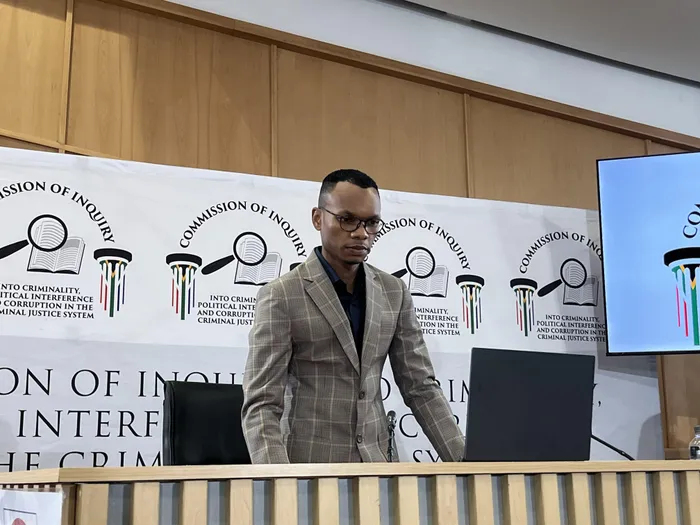
Suspended Tshwane CFO, Gareth Mnisi, has denied influencing tenders in the city for preferred bidders.
Image: Kamogelo Moichela / IOL News
If the Madlanga Commission has revealed anything, it is not simply that South Africa struggles with corruption. That diagnosis is too easy. Corruption is a symptom.
The deeper problem is that the state is losing its grip on something much more basic. That thing is a sequence. And when the sequence collapses, governance does not bend. It gives way. At the centre of (Gareth) Mnisi's testimony sits a question so basic that it should never need to be asked inside a functioning system.
What comes first? A quotation, a purchase order, or an invoice? That sounds trivial. It is not. It is a test of whether a system is governing itself or merely documenting what has already happened. In public procurement, sequence is not administration. It is authority. A need is identified. A quotation establishes price. A purchase order commits the state.
Delivery follows. Only then does an invoice request payment for what has already been agreed and supplied. That order is not conventional. It is a constraint. It is how systems slow decisions just enough for accountability to act.
Reverse it, and you are not bending rules. You are removing the very point where rules can intervene. What emerges from Mnisi's account is not strain but reversal. Invoices appear without origin.
Purchase orders follow transactions. Documentation trails reality, assembling itself after decisions are made. This is not an administrative disorder. It is governance failure in its purest form. Take a simple case. A supplier submits an invoice for R5 million. No quotation exists. A purchase order is created days later to regularise payment.
On paper, the file is complete. But the price was never tested. Competition never occurred. Authorisation never preceded commitment. The system did not approve the transaction. It reconstructed it.
A purchase order without a quotation means the price was never tested. An invoice without a purchase order means money is requested without prior authority. When both become routine, the system is no longer controlling transactions. It is chasing them.
Controls are meant to act before money moves. What we are seeing instead is controls arriving after the fact, rebuilding legitimacy retroactively. Paperwork no longer guides decisions. It explains them. And when a state explains spending after it happens, it has already lost control of that spending.
This is where governance becomes theatre. On paper, everything still looks intact. Purchase orders exist. Quotations exist. Approvals exist. The files are there. The boxes are ticked. But the sequence is gone. Without sequence, documents lose their function. A purchase order becomes justification, not authorisation.
A quotation becomes cover, not price discovery. An approval becomes a signature attached to an event that has already occurred. The system still produces paperwork. It no longer produces permission. Mnisi's testimony matters because it shows this downturn in motion, not as an anomaly but as a pattern.
Formal systems constantly catch up to decisions taken elsewhere. Defenders will say that reality is messy. Urgency intervenes. Systems lag. Officials improvise. That is true, but it is also irrelevant.
Governance is built for pressure. If controls only work in calm conditions, they are not controls. They are suggestions. A delayed purchase order is a weakness. A missing quotation is a breach. But an invoice arriving before both is something else entirely.
It is a suspension of the system. Once suspension becomes normal, consequences shift from procedural to fiscal. When the sequence disappears, the price is no longer discovered. It is declared. Commitments are no longer authorised. They are assumed. Payments are no longer conditional.
They are expected. Money moves not because obligation is verified but because obligation is reconstructed after the fact. This is how states lose money without dramatic theft. Not through complex schemes, but through quiet inversion. One transaction at a time. One exception at a time. One promise to fix the paperwork later.
Until leakage is no longer accidental. It becomes structural. And this is how state capacity erodes without announcement. A capable state is defined not by promises but by enforcement of sequence at the point of spending. Break that discipline, and capacity does not collapse overnight. It thins until the system can no longer hold a line.
Budgets lose credibility. Oversight loses force. Audits become reconstruction exercises, not verification tools. Eventually, the state no longer decides how money is spent. It discovers how it was spent. In that gap, even honest spending becomes inefficient. Sustained inefficiency becomes indistinguishable from loss.
What makes this failure dangerous is its familiarity. No complex instruments. No elaborate laundering. Just reordered steps. Missing links. Backdated documents. A system that learns compliance can be performed after the fact. Governance rarely fails dramatically. It fails through tolerance. A skipped step becomes acceptable.
A delay becomes routine. A reversal becomes invisible. By the time paperwork catches up, the money is gone. So, the question is not trivial. Does a purchase order come from a quotation or from an invoice?
In any system that governs itself, it comes from a quotation. Because governance is not about whether documents exist. It is about whether they exist before decisions. When that order is reversed, control does not weaken gradually. It disappears structurally.
The system can no longer distinguish between what was authorised and what is being explained. And once that distinction is gone, the state is no longer in control of its own spending.
Restoring sequence without paralysis
The answer is not more paperwork. South Africa does not lack documents. It lacks an enforced sequence.
But a perfect sequence can still be gamed. A genuine quotation from a shell entity followed by a clean purchase order still enables theft. The sequence stops after the fact justification, not pre-collusion. And urgency cannot always wait. So, the solution is not rigidity. It is an enforced conditional sequence.
First, systems must block reversed flows. No invoice without a valid purchase order. No purchase order without a timestamped quotation. Any override must be logged, justified, and escalated automatically.
Second, emergency procurement must compress the sequence, not break it.Faster steps, the same order. Emergency actions must be reviewed within 30 days and published.
Third, procurement systems must use tamper-proof time stamps so orders cannot be rewritten. If a quotation appears after a purchase order, the reversal must remain visible permanently. Fourth, dedicated sequence audits must examine order integrity, not just financial compliance. This is governance auditing, not accounting.
Fifth, repeated breaches must carry personal consequences. Loss of delegation. Formal misconduct action. Public reporting of repeat offenders.
A state that pays first and authorises later is not governing. It is settling accounts after the fact. A state that only settles accounts is not in control of public money.
It is recording its loss. The issue is not paperwork. It is a sequence. Until sequence is enforced by systems that cannot be negotiated with, the state will continue explaining decisions it never made. And that is not an administrative weakness. It is a rule failure. We do not need more documents. We need the right order. And we need it enforced before the money moves, not after.
Qwesha is a trade finance consultant with expertise in global commerce and risk management and regularly contributes to a number of publications