

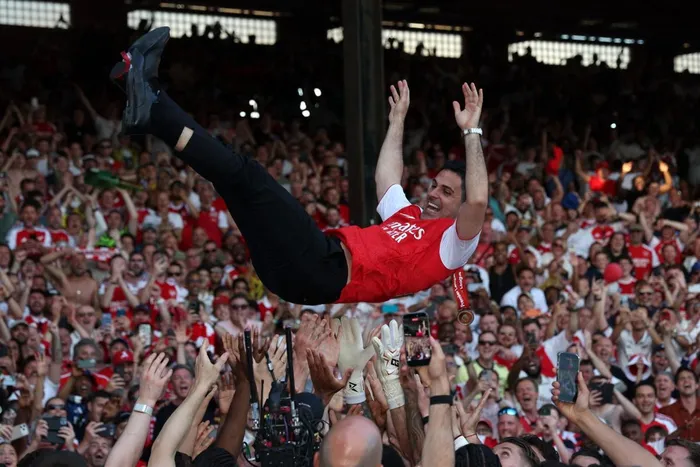
Arsenal have finally thrown off the 'bridesmaid' tag to claim the throne, while Manchester United are finally showing signs of genuine seriousness under Michael Carrick. Photo: AFP
Image: AFP
The babalaas of celebrating Arsenal fans hasn’t even faded, yet it’s time to take stock of another dramatic season. They’re really bottling it now (lol).
All that talk of bridesmaids had been laid to rest, and Daniel-san has finally shown Mr Miyagi a thing or two. Okay, I won’t bore you with more ‘80s film references, as we get down to the serious business of predictions for next season.
“But this one’s just finished,” I hear you groan.
The thing is, I apparently enjoy being proven wrong all the time (I count at least eight spectacular misses this season … but who’s counting?), so I might as well have another stab at it. Besides, as the Karate Kid has proven, comebacks are all the rage these days.
This season of remakes has also got me feeling nostalgic for one of the greatest rivalries in EPL history – between the Gunners and Red Devils. And it’s one I feel is already rebooting, with the roles of Alex Ferguson and Arsene Wenger to be played by Mikel Arteta and Michael Carrick.
“Pep’s just said his farewells and you’re already writing us off,” I hear Citizens crying.
“Serves you right for courting Enzo Maresca,” I’m tempted to respond, but I won’t.
The reality is that when clubs move on from legendary managers, things rarely go smoothly. Before Liverpool fans start waving Arne Slot’s title triumph around, I’d argue it barely counts as a proper transition when you keep the same squad and only tweak the previous manager’s tactical blueprint. So there.
Just like Chelsea, he is now going in reverse. The less said about Spurs, the better, with their membership of the Big Six revoked indefinitely, pending a review.
Into that uncertainty step two clubs who built the Premier League’s emotional foundations in the first place: Arsenal and Manchester United. And perhaps for the first time in many years, both look as though they are heading somewhere meaningful at the same time.
Arsenal, of course, have already arrived. After years of being football’s most aesthetically pleasing support group for disappointed idealists, Arteta’s side finally look like a team entirely comfortable with the burden of expectation.
The transformation has been gradual but unmistakable. Arsenal no longer merely play well; they control matches. Even when things wobble, there is less melodrama now; less existential crisis.
And then there is United.
Admittedly, predicting a United resurgence over the past decade has generally aged about as well as a prawn platter left in a car boot. Every promising corner turned was immediately followed by the club driving straight into another hedge. But this time feels slightly different.
There are signs – tentative, cautious, fragile signs – that United are rediscovering the one quality they lost most badly after Ferguson retired: seriousness.
If that continues, the Premier League may slowly drift back toward a rivalry that once defined English football globally. Because when Arsenal and United are both strong simultaneously, the league has a completely different energy.
Every meeting becomes theatre. Every title race gains narrative weight. Every touchline disagreement somehow feels historically significant even when it is probably just two coaches arguing about throw-ins. Even water bottles on the sidelines weren't safe, nor were fans from a certain flying Frenchman. But I digress.
English football, frankly, is more fun when these two clubs matter together.
That does not mean Manchester City will disappear overnight. Their infrastructure remains terrifyingly good even with Guardiola riding off into the sunset.
Nor does it guarantee Liverpool will vanish either. Great clubs rarely stay quiet for long.
But the league feels more open than it has in years. And in that opening, the familiar silhouettes of Arsenal and United are beginning to emerge once more – not as relics of the past, but possibly as the defining forces of whatever comes next.
Hopefully the sequel is as good as the original.