

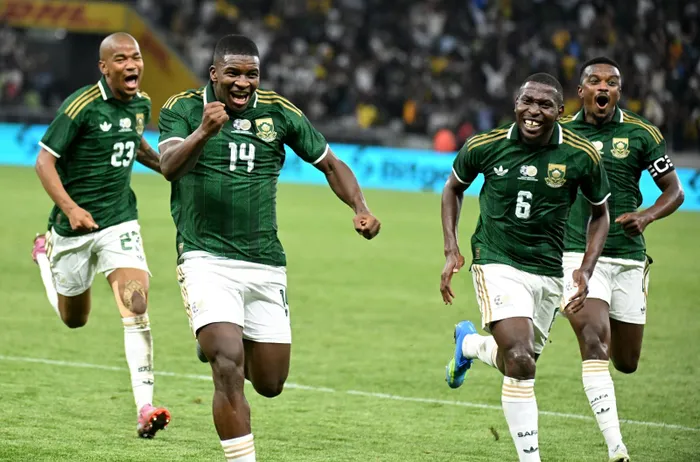
Young Bafana Bafana defender Mbekezeli Mbokazi scored a cracker against Panama in Cape Town.
Image: Ayanda Ndamane Independent Media
The 2026 Fifa World Cup is edging closer, and Bafana Bafana recently continued their preparations for the event during the latest Fifa window, highlighting both their readiness and their shortcomings.
Following the back-to-back international friendlies against Panama, we assess the key takeaways heading into the final Fifa window in May and the main event in North America, which kicks off on June 11.
Mbekezeli Mbokazi’s move to MLS side Chicago Fire was heavily scrutinised last summer. However, upon his return to national colours in the final game against Panama in Cape Town on Tuesday, Mbokazi showed clear signs of improvement.
He was defensively solid, making clean tackles and reading the game well, complemented by accurate distribution. He crowned an impressive outing with a cracking goal in the 64th minute, despite Bafana eventually going down 2-1.
Mbokazi is no stranger to scoring thunderbolts, having done so regularly at his former club, Orlando Pirates, but his movement on and off the ball reflects the high level of coaching in Chicago. It appeared seamless for him to reintegrate into the side and provide a steadying influence alongside Ime Okon.
Bongokuhle Hlongwane would have been desperate to impress in the Bafana set-up ahead of a World Cup co-hosted by the United States, where he and Mbokazi currently ply their trade.
However, the Nxamalala-born attacker had a night to forget upon his return to the national team after more than two years. In front of a sold-out crowd in Cape Town, Hlongwane was simply off the pace. He lost possession cheaply and missed a first-half sitter — a golden opportunity that may well have cost him his place in the final squad for the tournament.
The team has struggled to find effective strikers throughout the Broos tenure. While this was not always a primary concern, the narrative has shifted in recent months. The side endured a disappointing AFCON campaign largely due to the lack of a lethal number nine, as Lyle Foster was forced to carry too heavy a workload.
The same challenge has resurfaced during the preparation phase, with Broos lamenting that Foster appeared "a little lazy" at times. Given that Bafana’s success in North America depends entirely on their ability to convert chances, Broos must resolve these scoring woes, whether by bringing in specialist striking coaches or intensifying the scouting for natural goal-scorers.
Ronwen Williams is the undisputed Bafana number one, thanks to his shot-stopping and leadership qualities. However, he cannot do it alone; he requires a reliable deputy.
At the moment, it does not seem Broos has settled on a second-choice keeper to compete with Ricardo Goss, who appears set for the third-choice spot. Broos dropped Sipho Chaine for the recent window, replacing him with Renaldo Leaner, who made a second-half cameo against Panama and conceded two goals. While there was little Leaner could have done to prevent the goals, he did not do enough to cement his position either. Broos still needs to make a definitive call on who will deputise for Williams in the Americas.
Hugo Broos has already revealed his desire to face either European or Asian opposition in the final preparation match in June. This is a logical request, as Bafana face Czechia and South Korea in Group A, and Panama has already offered a snippet of what to expect against Mexico.
Broos’ wish must be granted by the mother body. SAFA must ensure the opponent is competitive enough to sharpen the team ahead of their first World Cup appearance in 16 years. Furthermore, the association needs to facilitate Broos’ request for a chartered flight from Johannesburg to Mexico City. A direct, private flight would smooth the travel schedule, allowing the squad ample time to recover and adapt at their base in Pachuca.