

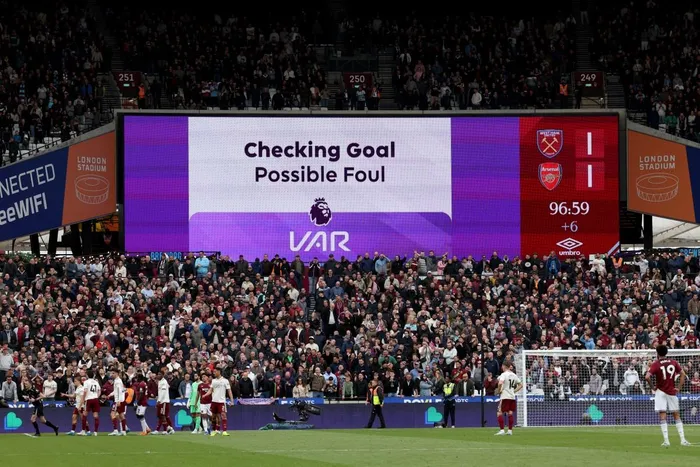
While VAR has divided opinion, the technology also has the power to ensure that some of the greatest footballing injustices of past World Cups are not repeated.
Image: AFP
For all the debate surrounding Video Assistant Referees, there is little doubt that technology has fundamentally changed the way football is officiated.
What began as a tool to correct "clear and obvious errors" has evolved into a far-reaching system capable of detecting the tightest offside calls, determining whether the ball has crossed the goal line, identifying unseen fouls, reviewing dangerous challenges and helping officials calculate more accurate added time to discourage time-wasting.
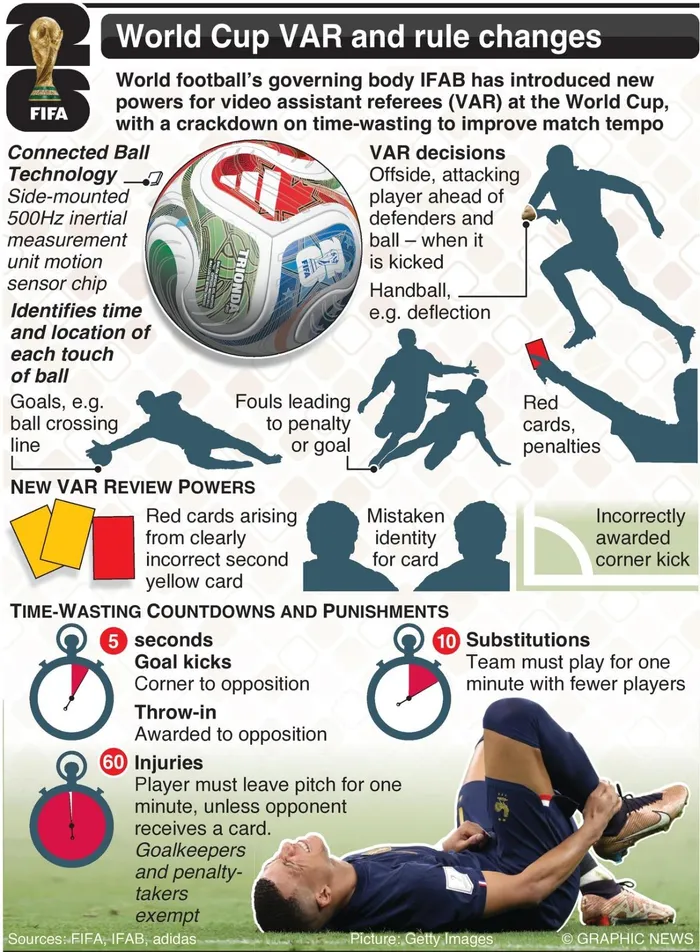
At the 2026 Fifa World Cup, the sport's governing body will take that evolution a step further. Connected match balls containing sensors will provide real-time data to assist officials in determining ball contact and offside situations. VAR review powers have also been expanded to include red cards arising from a clearly incorrect second yellow card and incorrectly awarded corner kicks, while time-wasting countdowns will also be introduced.
While modern technology has helped eliminate many officiating mistakes, it also raises an intriguing question: how different would World Cup history look if VAR had existed decades ago?
Several of the tournament's most iconic and controversial moments would almost certainly have had very different outcomes.
New VAR rules for 2026 Fifa World Cup
Image: Graphic News
In arguably the most infamous moment in football history, Argentina captain Diego Maradona leapt above England goalkeeper Peter Shilton and punched the ball into the net during their World Cup quarter-final. Referee Ali Bin Nasser and his assistants missed the handball and awarded the goal.
VAR Verdict: A review would have quickly identified deliberate handball in the attacking phase and the goal would have been disallowed.
The Outcome: Argentina won 2-1 and went on to lift the World Cup, with Maradona cementing his place among the game's greatest players.
The most debated goal in World Cup history arrived during extra time of the final between England and West Germany. Geoff Hurst's shot struck the crossbar and bounced down before being cleared, but Soviet assistant referee Tofiq Bahramov signalled that the ball had crossed the line.
VAR Verdict: Modern goal-line technology and VAR would have provided a definitive answer within seconds. Whether the goal stood or not, the controversy would have been settled immediately.
The Outcome: England won 4-2 after extra time to secure their only World Cup title.
One of the tournament's most shocking incidents occurred in the semi-final between West Germany and France. Goalkeeper Harald Schumacher charged into French substitute Patrick Battiston at full speed, knocking him unconscious and leaving him with broken ribs and damaged teeth. Remarkably, referee Charles Corver awarded neither a penalty nor a card.
VAR Verdict: Today's officials would almost certainly be sent to the monitor for a review of serious foul play. A red card and penalty would have been highly likely.
The Outcome: West Germany recovered from 3-1 down to draw 3-3 before winning on penalties. They eventually lost to Italy in the final.
England were trailing Germany 2-1 in their round of 16 clash when Lampard's shot struck the underside of the crossbar and bounced comfortably over the goal line before spinning out. Play continued despite television replays clearly showing the ball had crossed the line.
VAR Verdict: Goal-line technology would have awarded the goal instantly, while VAR would have confirmed the decision.
The Outcome: Instead of drawing level at 2-2, England remained behind and eventually suffered a heavy 4-1 defeat.
Argentina took the lead against Mexico in their round of 16 encounter when Carlos Tevez headed home from a Lionel Messi pass despite being clearly offside. Replays shown on the stadium's giant screen immediately exposed the mistake, prompting furious protests from Mexican players.
VAR Verdict: Semi-automated offside technology and VAR would have identified the infringement almost instantly and the goal would have been ruled out.
The Outcome: Argentina won 3-1 and advanced to the quarter-finals, where they were later thrashed 4-0 by Germany.
While VAR continues to divide opinion, these five incidents demonstrate just how dramatically technology can alter football's biggest stage. In each case, a single decision helped shape not just a match, but World Cup history itself.