

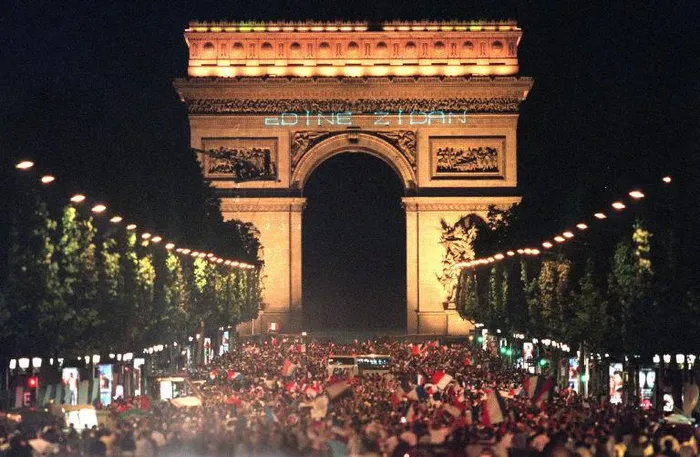
France celebrated their first Fifa World Cup after hosting the 1998 event. Photo: AFP
Image: AFP
The Fifa World Cup was expanded from 24 teams to 32 for the 1998 edition in France, and with it came a new format and rules.
The golden goal was introduced, as well as the use of three substitutes. Tackling a player from behind was also banned in an effort to protect the attacking player, which could arguably be considered the start of the era dominated by player power.
South Africa made their first appearance at the showpiece event. The nation had been previously expelled from CAF in 1958 for refusing to field a mixed-racial team, and then suspended in 1961 by Fifa. South Africa were formally expelled from Fifa, due to apartheid, as part of the larger sports boycott in 1976.
In 1992, the country was readmitted to Fifa with the creation of the non-racial Safa. South Africa had attempted to qualify for the 1994 edition of the World Cup in the US, but failed to progress further than the first-round group stages, losing out to Nigeria.
Four years later, Bafana Bafana won five of their seven games during CAF qualifiers to earn the right to represent the nation in France. They did so as former 1996 Africa Cup of Nations champions, and runners-up of the 1998 continental tournament.
There was another first for South Africa, with Ian McLeod becoming the first referee from the country to officiate a World Cup match when he was the whistleman for a Group D clash between Spain and Paraguay.
The World Cup was not without controversy, as it later transpired that Morocco had attempted to win the hosting rights of the event through the bribery of American football administrator Chuck Blazer.
Africa: Cameroon, Morocco, Nigeria, South Africa, Tunisia
Asia: Iran, Japan, Saudi Arabia, South Korea
Europe: Austria, Belgium, Bulgaria, Croatia, Denmark, England, France, Germany, Italy, Netherlands, Norway, Romania, Scotland, Spain, Yugoslavia
North America: Jamaica, Mexico, US
South America: Argentina, Brazil, Chile, Colombia, Paraguay
The iconic 80 000-capacity Stade de France was built for the tournament and was the centrepiece of the event. Several cities which had also hosted matches during the 1938 event — including Marseille, Toulouse, Bordeaux and Parc des Princes in Paris — were also selected for games.
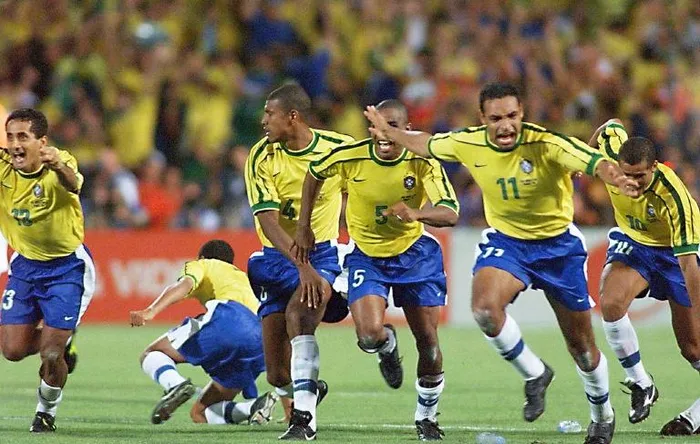
Brazil progressed to the final after a tense penalty shootout against Netherlands. Photo: AFP
Image: AFP
Eight groups of four teams were drawn for the event, with the top two teams from each group progressing to the next stage. FIFA attempted to get rid of 30 minutes of compulsory extra-time, should a knockout match be level after regular time, by introducing the sudden-death golden goal. France’s Laurent Blanc was the first player to score a golden goal when he did so in the 114th minute of their Round of 16 clash against Paraguay.
Ranked fourth in the world, Spain were surprisingly dumped out of the tournament at the end of the group phase. They only won one match in Group D, beating Bulgaria while drawing with Paraguay. They had previously suffered an opening-round shock 3-2 loss to Nigeria.
Of the five African nations that qualified for France, only the Super Eagles progressed to the knockout rounds of the tournament. Cameroon, Tunisia and South Africa did not win a single game, while Morocco managed to beat Scotland 3-0.
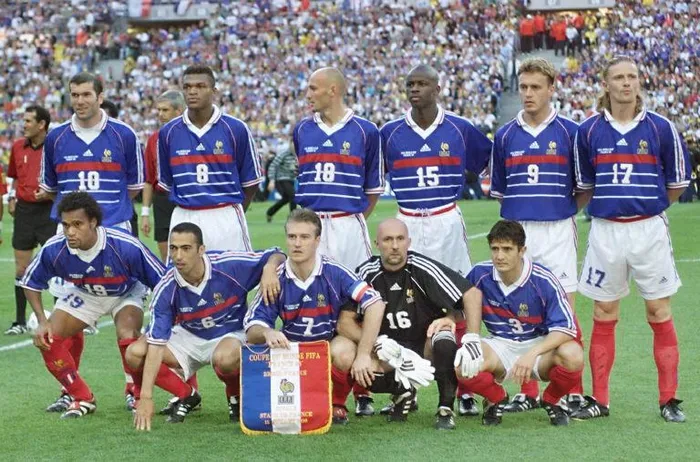
The France tea that won the World Cup. Photo: AFP
Image: AFP
Round of 16: Brazil 4, Chile 1; Nigeria 1, Denmark 4; Netherlands 2, Yugoslavia 1; Argentina 2, England 2 (Argentina won 4-3 on penalties); Italy 1, Norway 0; France 1, Paraguay 0; Germany 2, Mexico 1; Romania 0, Croatia 1
Quarter-finals: Brazil 3, Denmark 2; Netherlands 2, Argentina 1; Italy 0, France 0 (France won 4-3 on penalties); Germany 0, Croatia 3
Semi-finals: Brazil 1, Netherlands 1 (Brazil won 4-2 on penalties); France 2, Croatia 1
Third-place play-off: Croatia won 2-1 against the Netherlands.
Defending champions Brazil were the favourites to beat the hosts and retain their championship. They had a less-than-ideal matchday preparation, however, after talisman Ronaldo was at first omitted from their final teamsheet.
It transpired that Ronaldo had suffered a convulsive fit in the afternoon and spent a handful of hours in hospital. Nonetheless, he decided to play in the final, with Brazil submitting a modified teamsheet at 8.18pm with a 9pm kick-off looming.
France great Zinedine Zidane scored a brace in the first half, with Emmanuel Petit completing the 3-0 rout in the 93rd minute. It was Brazil’s heaviest defeat at the World Cup until their infamous 7-1 crushing in 2014.
After a tense semi-final between Brazil and the Netherlands ended 1-1 after extra-time, Brazilian defender Ricardo Rocha attempted to lift the mood of his teammates ahead of the penalty shootout. Rocha bellowed: "Let's do the same as those Japanese, the Kawasakis," confusing the motorbike manufacturer with the Japanese kamikaze pilots of World War II.
The team reportedly all burst out laughing at the gaffe and went on to progress to the final, winning 4-2 on penalties.