

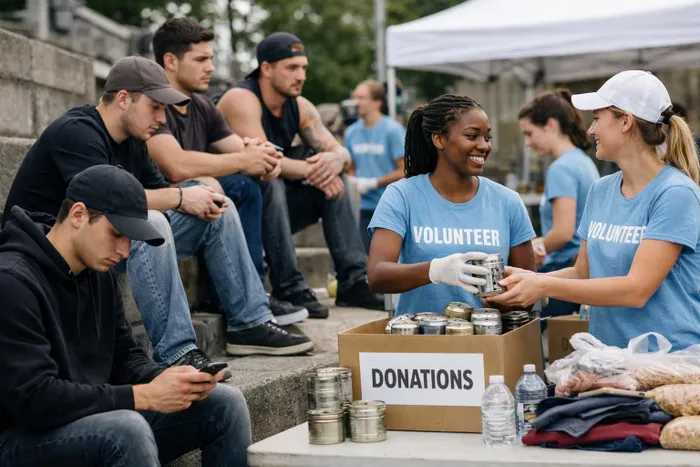
Only one male volunteer showed up at last weekend’s community day, underscoring the story’s question: Where are the boys?
Image: AI generated
Last weekend we hosted a volunteering day. Twelve volunteers showed up, ready to give their time, energy, and compassion to help others.
Only one of them was male.
For anyone working in community service, this pattern will sound familiar. Across many volunteer initiatives, women and girls significantly outnumber men and boys. While their commitment is inspiring, it raises an important question:
At the same time, a growing number of documentaries and studies are highlighting the rise of the “manosphere”, online communities where certain influencers promote hyper-masculinity, resentment toward women, and the idea that empathy or community engagement is weakness.
When young men are repeatedly told that caring about others is “soft,” it becomes easier to see why volunteering may not appeal to them.
But disengagement from community doesn’t just affect volunteer numbers. It affects the wellbeing of young men themselves.
Volunteering Is Often Presented in Ways That Don’t Appeal to Boys
Many traditional volunteer activities focus on caregiving roles: packing donations, serving food, or administrative work. These are essential tasks, but research shows men are more likely to volunteer in roles that involve problem-solving, teamwork, or physical activity.
Projects that involve building, fixing, protecting, or leading often attract more male volunteers.
If volunteering feels passive, boys may struggle to see themselves in those roles.
Online Influencers Are Shaping Masculinity
Social media has become a powerful force in shaping how young men view the world. Some influencers in the so-called “manosphere” promote a version of masculinity built around dominance, wealth, and individual success.
In this narrative, helping others, volunteering, or building community is sometimes portrayed as weakness.
When these ideas spread widely, they can quietly discourage young men from participating in activities that build empathy and social responsibility.
The Absence of Male Role Models in Volunteering
Young people often follow what they see.
When volunteering spaces are mostly filled by women, boys may unconsciously assume that community service is “not something guys do.” Yet historically, many forms of volunteerism, firefighting, rescue teams, conservation work, coaching youth sports, were strongly male dominated.
Boys need to see men actively participating in service to recognise that helping others is a powerful form of leadership.
Ironically, volunteering offers exactly the things many young men say they are missing purpose, belonging, and respect.
Volunteering can help boys develop:
Studies consistently show that volunteering improves wellbeing and helps build stronger, more connected communities.
For young men searching for direction, service can become a powerful anchor.
Perhaps the most important shift we can make is cultural.
Helping others should never be seen as weakness.
Real strength is shown in responsibility, courage, and leadership. Volunteer service allows young men to demonstrate exactly those qualities.
When boys volunteer, they are not just helping others.
They are learning what it means to be capable, compassionate men.
And when we create opportunities that speak to their strengths, challenge their abilities, and give them purpose, we may discover that boys don’t lack the desire to help.
They just need an invitation that feels like it belongs to them.
If we want stronger communities tomorrow, we must start by inviting boys and young men back into the work of building them today.
If your organisation has any opportunities that can appeal to men, please reach out info@volunteernow.co.za