

A health policy expert and oncologist talks about his “six simple rules” for living longer and better.
Image: Supplied
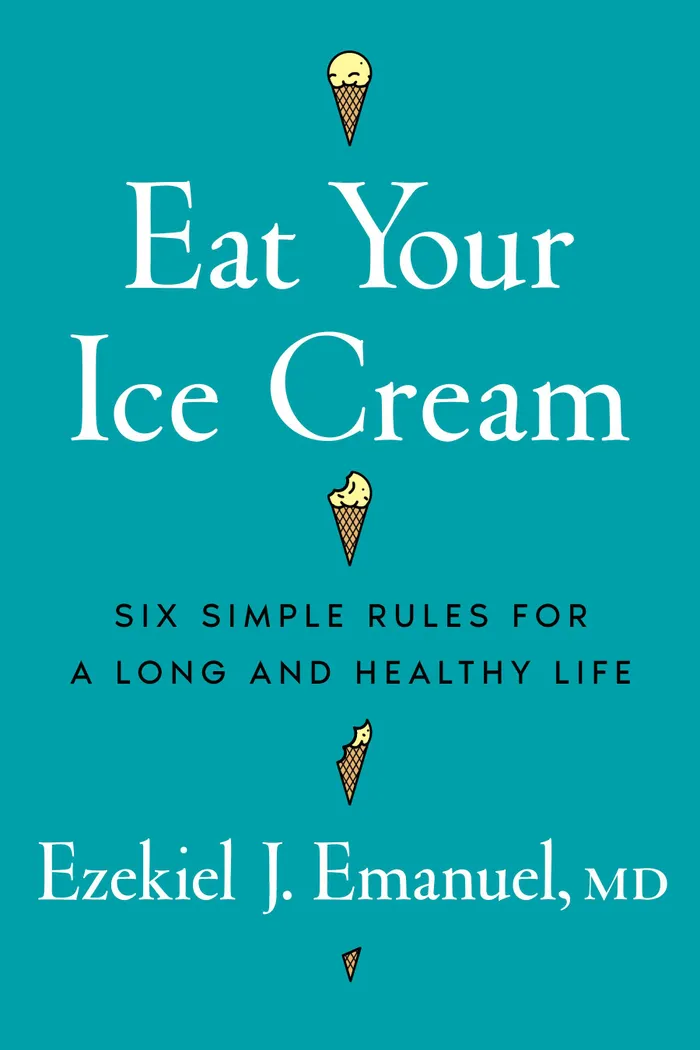
In Ezekiel Emanuel’s “Eat Your Ice Cream,” the health policy expert and oncologist talks about his “six simple rules” for living longer and better. The wiry and intense 68-year-old is no scolding nutritionist, readily admitting his love for sweet treats - he ate banana splits as a kid and now regularly bakes apple crisps, banana cake and his mother’s cheesecake - but he indulges only a couple of times a week and in small portions.
Emanuel, who is also the vice provost for global initiatives at the University of Pennsylvania, recently sat down to discuss his eighth book. This interview has been edited for length and clarity.
Why do we need another book on how to live a long and healthy life?
Mostly, the books we have are the wrong kind. We are on this earth a mere 75, 85, maybe 90 years. We should make the most of those years, and obsessing over getting a few extra days is not a good way to spend your time. You have to focus on core items. You don’t focus on the latest fad, because almost invariably it’s going to be wrong, or it was discovered in toads or mice. I don’t talk about what happened in mice. I talk about results in people. All these people writing books just infuriate me - they’re selling you things. I am selling you nothing. I don’t have a supplement, I don’t have tests, I don’t have consultations, I don’t have some magic potion that I’m going to give you.
Your book has only six rules, starting with, “Don’t be a schmuck.” What does that mean?
There are lots of things in life that have unreasonable risks, and you should not be doing them. We obviously know about smoking. While vaping may be safer than smoking, that doesn’t make it safe. We need to think about that.
You’re stepping into the firing line about vaccines and guns - tell us about that.
Robert F. Kennedy Jr. is doing on vaccines is horrible. It doesn’t recognise how dreadful these infectious diseases were, or how much your grandparents probably couldn’t wait to get their kids vaccinated against polio, then measles and all the other illnesses that we got vaccines for. One consequence of the success of the vaccines is that we don’t see these diseases. When it comes to gun ownership, this is data-driven. If you own a gun to protect yourself, you are twice as likely to die by a gun as your neighbour. Why? Because most gun deaths are by someone you know, a relative or a friend. The number one cause of kids’ death now is guns because guns are stored at home. They’re loaded, they’re not stored in a safe place, and there are no locks. I think the data support gun restrictions, which leads to people living. I’m a doctor, and people's lives are my primary goal.
Why does your chapter about cultivating relationships come before diet, exercise and sleep?
There are myriad studies showing that people with more and richer social interactions actually live longer. A lot of people think: “Oh, this is psychological. It’s in the head.” Well, it is in the head, but that doesn’t make it psychological. Interacting with people decreases cholesterol and cortisol (stress hormones) and lowers our heart rate and blood pressure. These are physiological impacts. Not having friends, being socially isolated, that’s the equivalent of smoking 15 cigarettes a day.
You write that “ice cream improves people’s health.” Say what?
I still like ice cream - gelatos, speciality ice creams - and they’re dairy products, which are quite good for you. They give you protein, vitamins, and other nutrients, and can lower the risk of heart problems. If you eat ice cream once a week, twice a week, it can be fantastic. My wife’s grandmother, who lived to 101, used to have a scoop of ice cream every day. She would say, “There’s always a little room for ice cream.” Assuming you eat nutritiously, don’t consume a lot of ultra-processed foods, and don’t have many empty calories from sodas, it can be fine.
Tell me about the chapter called “Expand your mind.”
[It’s about what] hell is for most people - the body’s okay, the heart’s working, the kidneys are working, but the brain is not. There are two key elements. One is cognitive reserve - do you start with a high level of brain functioning? We’re in a moment where people are obsessed with the economic value of a college education. That’s one way of looking at it. But there’s also a cognitive value to an education. Actually reading Dostoevsky, not just the AI summary, is important to your brain. It makes connections, and the more connections you have, the better. Keep your brain active. We know that cognitive decline begins in the late 30s, early 40s, and really goes down once people retire. And the best way of countering that, besides exercise, eating well, and socialisation, is staying mentally engaged.
What do you say to people who hate exercising?
Not getting any exercise is dangerous. What you can do is not make it an exercise, not make it “go to the gym,” not make it, “I’m going to go out for a seven-mile run.” You can hike with someone else, so it’s more of a social activity. In the winter, 20 minutes a day of doing yoga or riding an exercise bicycle is going to do you well.
What about alcohol? I find the current guidelines confusing.
From a physical standpoint, drinking alcohol is probably not a good thing. It’s bad for your liver, and it’s associated with increased risk of at least seven cancers. There may be a group of men over 55 who are at high risk of cardiac disease, where some alcohol is protective, but that’s the bottom line. Three to four drinks a week. You shouldn’t be drinking five drinks in an evening. You shouldn’t be drinking alone.
You have a good sense of humour - should that be the seventh rule?
A hundred percent. Having fun in life, looking forward to things - you’ve got to think about something new all the time. I think exuberance is a secret of life because it’s enjoyable, it’s intellectually challenging.