

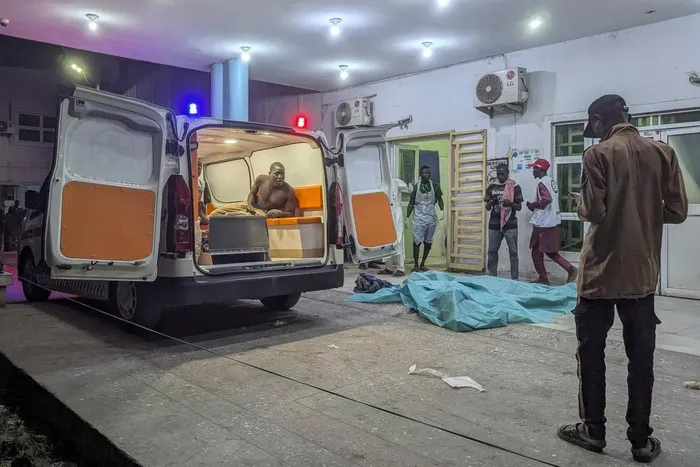
An injured man peers from an ambulance outside a hospital in Maiduguri on March 16, 2026, following multiple explosions that shook the northeastern Nigerian city that evening.
Image: AFP
Multiple explosions staged by suspected suicide bombers have killed at least 23 people and injured more than 100 in the northeastern Nigerian city of Maiduguri, in what authorities say is a resurgence of militant violence in the region.
The three blasts struck on Monday evening, a day after suspected jihadists attacked a military post, shattering a period of relative calm in the city.
Police spokesman Nahum Kenneth Daso said a preliminary investigation pointed to suicide bombers.
"Preliminary investigation reveals that the incidents were carried out by suspected suicide bombers," he said.
"Regrettably, a total of 23 persons lost their lives, while 108 others sustained varying degrees of injuries," he added.
The attacks targeted crowded locations, including the city’s main market, the gate of the University of Maiduguri Teaching Hospital and the area around the Post Office flyover.
An AFP reporter at a local hospital saw dozens of wounded people seeking treatment, as well as multiple bodies covered by sheets outside the facility.
An anti-jihadist militia member told AFP the death toll could be as high as 31.
Witness Mala Mohammed, 31, described scenes of panic following the initial blasts.
"At that moment, we were not sure what had happened. But after about two or three minutes, other people who were running along the road started shouting that it was a bomb at the market entrance.
"Many of them ran toward the Post Office area because the market entrance and the Post Office are not far apart. Unfortunately, as they were running towards Post Office, the person who had the explosive device ran into the crowd while people were still trying to escape," he said.
The violence follows an earlier overnight attack on a military position in the Ajilari Cross area, just a few kilometres from the city’s airport. Another attack was also reported in the Damboa local government area south of Maiduguri.
The incidents mark a renewed wave of violence blamed on jihadist groups Boko Haram and Islamic State West Africa Province, which have intensified operations in northeastern Nigeria.
Their 16-year insurgency has killed more than 40 000 people and displaced around two million.
Babagana Zulum condemned the attacks as "barbaric", linking the recent surge in violence to intensified military operations in the Sambisa forest, a known militant stronghold.
Police said on Tuesday that "normalcy has been fully restored in the affected areas" and that security forces have increased their presence and surveillance across the city to prevent further attacks.