

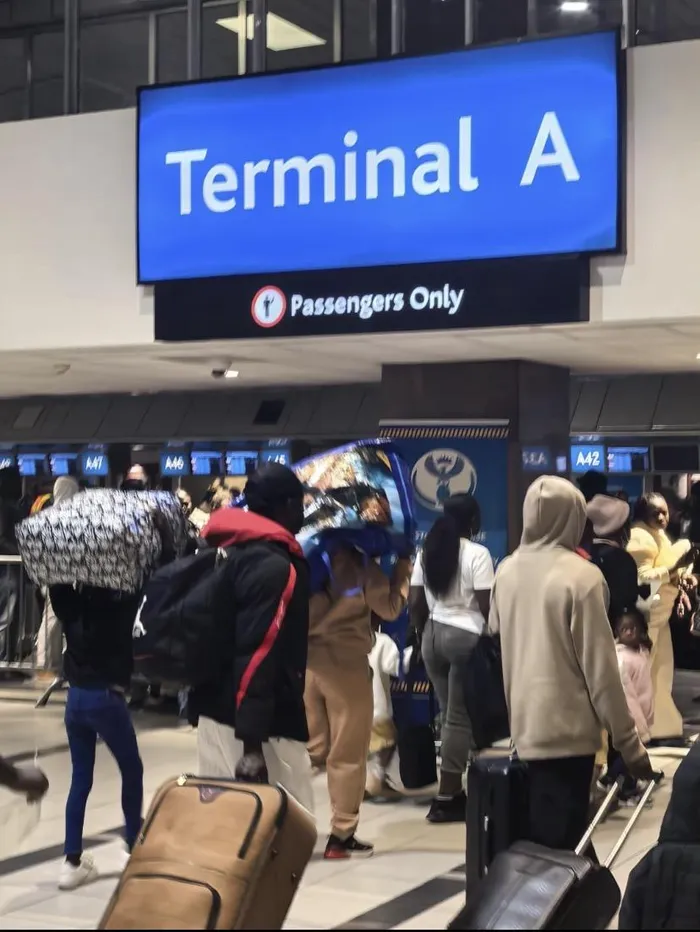
After an extensive immigration screening at OR Tambo International Airport, 295 undocumented Ghanaians were repatriated from South Africa, highlighting the challenges of immigration enforcement.
Image: BMA
South Africa cannot expand its business footprint across the continent while refusing to reckon with what regional integration demands.
There is a boardroom conversation happening in Johannesburg, Cape Town, and Sandton that almost never appears in the immigration debate. A South African bank is finalising its expansion in Kenya. A retailer mapping logistics corridor through Zambia and Mozambique.
A telecoms group is negotiating spectrum rights in four SADC countries simultaneously. Capital is moving north. It iswelcomed. It is celebrated as evidence of South African dynamism and regionalleadership.
Then the conversation shifts to a taxi rank in Johannesburg, or a communitymeeting in Limpopo, or a ward council in the Cape Flats, and the same country that insists on unfettered access to African markets becomes loudly impatient with African people moving toward its own.That contradiction is not a talking point. It is a structural problem.
And South Africa will not resolve it by pretending it does not exist.The frustration driving the immigration debate is real and should be taken seriously. A democracy corrodes when citizens feel their concerns are dismissedrather than answered.
South Africa's immigration system is genuinely failing,not metaphorically, not in isolated cases, but systemically. Backlogs are severe. Permit processes collapse under their own dysfunction. Border management oscillates between neglect and crisis response. That failure is the governments to own, and it has been slow to do so honestly.
But something else is also true, and it is the thing political leadership on everyside of this debate seems least willing to say plainly: South Africa's economy is already regionally integrated. Not in aspiration.
In fact. Entire sectors of theinformal economy depend on cross-border labour while publicly performingignorance of that dependence. Agriculture. Construction. Domestic work.Hospitality.
These sectors do not function at their current scale without migration. The question is not whether South Africa has a relationship withregional labour, but whether that relationship will be governed or merelyexploited.
A state that refuses to answer that question honestly does not protect its workers. It abandons them to an informal labour market where the absence of regulation hurts everyone: South African workers who cannot enforce fairwages, and migrant workers who cannot enforce anything at all.
''The question is not whether South Africa has a relationship with regionallabour. It is whether that relationship will be governed or merely exploited.'' There is a further dimension that demands uncomfortable clarity.
Many of the failures now attributed to immigration were already accumulating beforemigration intensified. Municipalities are collapsing under debt andmismanagement. A permitting system so dysfunctional that no one citizen or foreigner can navigate it reliably. Public hospitals that would be overwhelmedwith or without immigration pressure.
These failures have authors, and those authors are not migrants. Redirecting public anger toward immigration as the explanation for institutional collapse is not just analytically dishonest. It is politically dangerous because it trains citizens to misidentify the problem,which means they will keep electing people who misidentify it with them. None of this means borders are unimportant. They are not.
A state that cannotmanage entry and exit is not a state exercising sovereignty; it is a stateperforming it. South Africa needs functional immigration administration,credible enforcement, and labour market regulation that works.
It needs to stoppretending that the informal economy's relationship with undocumented labouris a secret and begin governing it as the structural feature it is.The harder argument is this: South Africa cannot be a regional economic poweron one side of a ledger and wash its hands of regional obligations on the other.
The two are connected. The access South African companies enjoy in Kenyan,Zambian, and Mozambican markets rests partly on a perception of South Africa as a partner in African development, not merely a capital exporter extracting returns and sending them home. That perception is not infinitely durable.
It willnot survive indefinitely if the political discourse in Pretoria treats Africanmigration as a pure threat. ''South Africa cannot be a regional economic power on one side of a ledger andwash its hands of regional obligations on the other.''
What South Africa needs is not a harder line or a softer tone. It needs an honestone.
An immigration system that functions, enforces, and treats people,including those it turns away, with the dignity of consistent law rather than arbitrary discretion. A government willing to say, publicly, that regional interdependence is a feature of South Africa's economic future, not a threat to it.
A business community willing to acknowledge that you cannot want African market access while remaining indifferent to African welfare.
And a citizenrythat can hold two things at once: that borders matter, and that turning migrantsinto the explanation for every dysfunction is a story designed to protect thepeople responsible for those dysfunctions. South Africa is capable of that conversation. It has handled harder ones.
But itmust be willing to start with the contradiction, not talk around it.The price of having it both ways is already being paid. The only question is who keeps paying it.
Qwesha is a trade finance consultant with expertise in global commerce and risk management and regularly contributes to a number of publications