

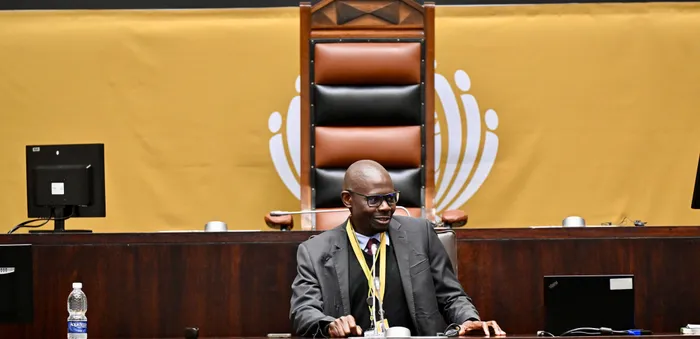
As chairperson, Gana will now lead the committee in carrying out its responsibilities under Section 89 of the Constitution.
Image: Phando Jikelo
The appointment of Makashule Gana, a Member of Parliament from RISE Mzansi, as Chairperson of Parliament's Section 89 Impeachment Inquiry Committee may appear to be a procedural development in the evolution of South Africa's constitutional accountability mechanisms.
Most commentary has focused on questions of political neutrality, partisan advantage, or the symbolic significance of an opposition figure overseeing one of Parliament's most consequential constitutional processes.
These analyses, however, may be missing the deeper constitutional significance of the moment.
The truly profound question is whether Gana's appointment signals the emergence of a new accountability elite within South Africa's constitutional order—one that sits outside traditional party structures and gradually acquires institutional authority over the ultimate sanction available against a Head of State.
The significance of Section 89 lies not merely in its capacity to remove a President. It lies in the fact that it creates a constitutional mechanism through which Parliament acts as the guardian of constitutional legitimacy itself. When Parliament initiates a Section 89 process, it is not performing ordinary legislative oversight. It is exercising a quasi-constitutional function, determining whether the holder of the highest office in the Republic remains constitutionally fit to govern.
This raises a fascinating constitutional paradox.
In mature democracies, dominant political parties often control impeachment mechanisms because those parties command legislative majorities. South Africa's evolving political landscape, however, is increasingly fragmented. Coalition politics, declining majority dominance, and the rise of smaller parties are producing new constitutional realities.
In this environment, the chairpersons and procedural custodians of accountability mechanisms may become more influential than the political parties themselves.
Gana's appointment may therefore represent something far more consequential than a committee assignment. It may be an early indication that South Africa is entering an era in which constitutional authority migrates away from electoral majorities and toward institutional brokers who possess procedural legitimacy.
The implications are profound.
Historically, constitutional democracies have been studied through the lens of three centres of power: the executive, the legislature, and the judiciary. Yet South Africa may be witnessing the emergence of a fourth centre of influence: constitutional gatekeepers.
These are individuals who may not command large electoral constituencies but who occupy strategically significant positions within accountability institutions. They become custodians of processes rather than holders of executive power.
The Chairperson of a Section 89 Inquiry precisely occupies such a position.
The chair determines procedural fairness, guides evidentiary processes, manages constitutional interpretation within the committee's mandate, and shapes the institutional legitimacy of the inquiry itself. While the committee does not decide the final parliamentary vote, the credibility of the process often depends on the perceived legitimacy of its leadership.
This introduces an entirely new field of constitutional inquiry.
What happens when constitutional legitimacy becomes increasingly dependent not on political majorities but on procedural custodians?
What happens when the most consequential constitutional actors are not Presidents, party leaders, or judges, but institutional referees?
What happens when democratic authority gradually shifts from electoral dominance to constitutional stewardship?
These questions have received remarkably little attention in South African scholarship.
The conventional assumption is that accountability mechanisms merely constrain power. Yet accountability mechanisms can also generate power. Those entrusted with overseeing constitutional accountability acquire influence precisely because they stand at the intersection of law, politics, and institutional legitimacy.
In fragmented democracies, this influence can become structurally significant.
A future historian may look back on appointments such as Gana's and identify them as early manifestations of a broader constitutional transition: the movement from majority-governed accountability to institution-governed accountability.
This possibility becomes even more intriguing when viewed through the lens of South Africa's constitutional design.
The Constitution was drafted with the assumption that democratic legitimacy would flow primarily from electoral representation. However, the rise of coalition politics is forcing accountability institutions to develop independent legitimacy. The public increasingly trusts processes rather than parties, procedures rather than personalities, and institutional integrity rather than partisan loyalty.
If this trend continues, the chairpersons of constitutional inquiries may become central figures in maintaining democratic stability.
The appointment of Makashule Gana may therefore be remembered not because of the outcome of any Section 89 process, but because it symbolises the emergence of a new constitutional phenomenon: the rise of constitutional intermediaries whose authority derives from stewardship rather than sovereignty.
This is not merely a political development.
It is potentially the beginning of a new constitutional era.
The most important question is therefore not whether Gana is the right person for the role. The deeper question is whether South Africa is witnessing the creation of a new class of constitutional actors whose influence will shape the future of democratic accountability long after the current political controversies have faded.
If that is indeed what is occurring, then the appointment deserves to be studied not as a parliamentary event, but as a constitutional turning point.
Mbikwana is a scholar writing in his personal capacity on matters of constitutional law and democratic governance.