

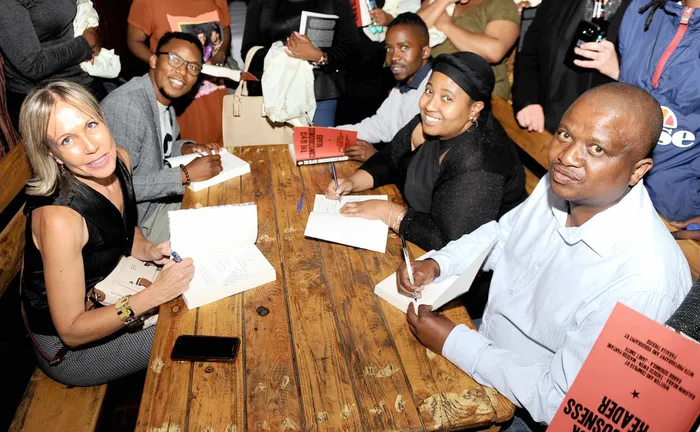
Janet Smith, Paballo Thekiso, Rabbie Serumula, Masego Panyane, and Baldwin Ndaba (far right) during the launch of their book, The Black Consciousness Reader, in Newtown.
Image: Picture: Nokuthula Mbatha / ANA
The media fraternity mourns the loss of Baldwin Ndaba, a talented, committed, hardworking, and fearless journalist who left an indelible mark on the profession.
It is sad and painful that the noble craft of journalism, to which Ndaba dedicated his entire working life, turned out to be cruel and unkind to him, as it did to many other media practitioners - journalists, photojournalists, sub-editors, and others - most of whom served with aplomb, while others are dying in silence.
Despite giving his all, Zithulele Tsielala Baldwin Ndaba joined throngs of journalists who quietly and silently bore the invisible scars of the brutality of journalism. Many journalists are suffering in silence in newsrooms due to various factors, including retrenchments, being expected to do more with less, salary cuts, and lack of unions.
Others resent giving their all to journalism, especially in print media. The recent closure of City Press has left many asking themselves, including aspirant journalism students, "What's next?" Is there a future in journalism? "Should we follow in the shoes of the likes of Percy Qoboza, Joe Thloloe, Thami Mazwai, Mathatha Tsedu, Sophie Tema, Nomavenda Mathiane, Maud Motanyane, Paula Fray, Lizeka Mda, Zingisa Mkhuma, and others?"
Over the years, Ndaba joined the long queue of experienced journalists and photographers who were unceremoniously shown the door and kicked out at their prime. He had a lot to offer in nurturing, grooming, mentoring, and coaching cub reporters.
Ndaba, who passed away on his bed last Friday, will be buried on Saturday and the service will be held Kimberly City Hall at 9am. A memorial service will be held on Friday at Galeshewe Recreational Hall at 2pm.
His death has not only touched those who came into contact with him, former journalism students and colleagues at both the Diamond Fields Advertiser and The Star, where he spent his considerable journalism career breaking exclusive stories, but also colleagues from other media houses and government communicators alike.
Veteran journalists such as Ntate Bokwe Mafuna opened up on social media, saying, 'Baldwin Ndaba. I only knew his writing. I wish we had met. What a tribute from Themba Sepotokele, which tells us he was one of the best. What a wonderful community of media workers our country has been blessed with. Hamba Kahle... Mnakwethu!'
Former ANC Gauteng spokesperson Mankwana Papo described him as a dedicated journalist who was also committed to the cause of social, cultural, and economic liberation of our country.
One person who was devastated when I shared the news was the former newsroom administrator, Sis' Thandi Mabuza, who left me in tears with her WhatsApp voice note, saying, 'Au Nkosiyam' Themba, shame Uzithulile wan'! Kwa hamba abantu basa sebancane. Kwa hamba uSolly (Maphumulo), uPoloko (Tau). Manje Zithulele wan'. Beba hlala bonke edeskini emsembenzi. Wah! Zithulele.'
Born on December 22, 1972, in the dusty streets of Galeshewe, Kimberley, the province that gave birth to legendary scribes such as Sol Thekiso Plaatje and Aggrey Klaaste, whose names are inscribed in the history of the country, Baldwin Ndaba, known to some as Baldi by fellow journalism students at Rhodes University.
Ndaba, as fellow journalist and friend, Siyabonga Mkhwanazi used to call him after downing a couple of cold ones, was a brave and brilliant journalist, yet fearless
Despite nailing his colours to the mast, Ndaba was a proud PAC supporter but never let his party loyalty collide with journalism ethics.
When he joined The Star newsroom, he announced his presence with a bright smile. Clad in a black leather jacket, which became his signature, Ndaba was set apart from the rest of us because he was multilingual; he spoke English, Afrikaans, Setswana, and isiXhosa fluently.
He was part of the Crime Desk, working closely with Gill Gifford, and later became a political reporter, covering the Gauteng Provincial Legislature. Ndaba was a gentle giant, humble yet sharp. Apart from his black leather jacket, his infectious laughter and snide smile were his signatures.
On Thursdays, we would gather at a famous watering hole adjacent to Luthuli House. He loved life, liked his bottle, and was a regular at the quarterly Gauteng Provincial Government Communication Forums where journalists and spokespersons would discuss and dissect the media and political landscape and thereafter imbibe waters of immorality until the bar was closed.
I used to drive both Siyabonga Mkhwanazi and Baldwin Ndaba to Soweto for a few cold ones, as they both came from KwaZulu-Natal and the Northern Cape, respectively.
His pen was dropping with ink, earning him friends and foes alike. He exposed malfeasance in the dark corridors of power, rattling cages and ruffling feathers.
He exposed the malfeasance of the-then Gauteng Housing and Local Government MEC Humphrey Mmemezi for using the government's credit card to buy McDonald's, something which actually put Mmenezi's spokesperson, Motsamai Mothlaolwa, who studied journalism with him at Rhodes University, in an awkward position as he was expected to douse the fires.
I remember having a discussion with him, asking me for some information about Mmemezi, only to find that I was blank despite working in the department opposite The Star building, the now burnt and derelict Bank of Lisbon. His sources provided him with shocking details about malfeasance perpetrated by Mmemezi, including driving with his VIP protectors to his homestead in the Eastern Cape, where he also used a government credit card to buy groceries.
One of the bemusing stories he told me while sitting at The Star canteen left me in stitches. He told me how Mmemezi had apparently called the manager of FNB, located in The Star building, to not allow customers at a certain time since he was coming to the bank.
All that he wanted was someone to corroborate and verify the claims. Apart from being in the dark, I was not working in the political office; suffice to say, as a government communicator, mine was to defend the reputation of the government.
With the evolution of the media, especially print media and changes at Independent News, Ndaba wrote for Sunday Independent and Saturday Star. In the end, he was one of those journalists who lost their jobs.
He loved his wife and he was fond of his children and grandchildren. He sacrificed everything for them. He once told us he bought his wife a car, yet he relied on public transport and sometimes walked to work.
Journalism can be unkind; journalism can be brutal. Lalangoxolo Ndaba. Robala ka kgotso!