

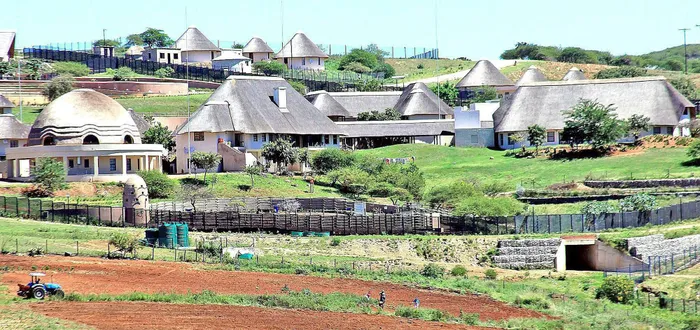
Former president Jacob Zuma's residence in Nkandla. The Phala Phala judgment may become one of the defining constitutional decisions of South Africa’s coalition era. Unlike in 2016, the ANC no longer governs with overwhelming parliamentary dominance, says the writer
Image: File
The arc from the Nkandla scandal in 2016 to the Phala Phala scandal in 2026 feels less like coincidence and more like constitutional déjà vu. Different facts, different presidents, same institutional question: what happens when political power collides with constitutional accountability?
In both moments, the courts were forced to remind the state of a foundational democratic truth — legitimacy is not secured by electoral majorities, party loyalty, or presidential popularity. It is secured by fidelity to the Constitution.
The recent judgment of the Constitutional Court of South Africa ordering Parliament to revive the impeachment process against President Cyril Ramaphosa over the Phala Phala affair is therefore not merely a procedural development. It is a constitutional intervention into the culture of political impunity that has increasingly threatened the credibility of South Africa’s democratic institutions.
At the centre of the judgment lies Section 89 of the Constitution — the impeachment mechanism designed not as a political weapon, but as a constitutional safeguard against executive abuse. The Court’s essential finding was devastating in its simplicity: Parliament cannot use its majority power to evade its constitutional obligation to hold the President accountable.
This is precisely the principle that emerged from the Nkandla era. In the landmark 2016 judgment of Economic Freedom Fighters v Speaker of the National Assembly, the Constitutional Court held that Parliament had failed in its constitutional duty by shielding then-President Jacob Zuma from accountability regarding the misuse of public funds for upgrades to his Nkandla residence. Chief Justice Mogoeng Mogoeng famously declared that the Constitution is the “supreme law” and that no public office bearer is above it.
A decade later, the same institutional pathology has resurfaced.

Anda Mbikwana.
Image: Supplied
The facts of Phala Phala differ from Nkandla in important respects. Nkandla concerned the unlawful expenditure of state resources on private luxury upgrades. Phala Phala concerns allegations surrounding the concealment of foreign currency, the reporting of a burglary at the president's private farm, and the alleged use of state security resources in response to a private criminal matter. Ramaphosa has consistently denied wrongdoing and maintains that the money originated from legitimate game sales.
Yet constitutionally, the issue before the Court was never ultimately about buffalo sales, couches stuffed with dollars, or internal ANC factionalism. The deeper question was whether Parliament exercised independent constitutional judgment or merely reproduced executive protectionism through partisan voting discipline.
The Court has now answered that question with unmistakable clarity.
The significance of this ruling extends beyond Ramaphosa himself. It reasserts an often-neglected constitutional doctrine: Parliament is not merely a political chamber; it is an accountability institution. Members of Parliament are not constitutionally employed to defend party presidents. They are entrusted to defend constitutional governance.
This distinction matters profoundly in a dominant-party democracy such as South Africa’s, where the line between party loyalty and constitutional duty has historically become dangerously blurred. The African National Congress, like many liberation movements that transitioned into governing parties, has often struggled to distinguish criticism of the president from attacks on the movement itself. The result has been an erosion of institutional independence across multiple spheres of governance.
Phala Phala therefore represents more than scandal fatigue. It represents a stress test for post-apartheid constitutionalism.
The Court’s intervention also exposes the paradox of South Africa’s democratic evolution. Increasingly, constitutional accountability is being preserved not by political institutions voluntarily acting with integrity, but by courts compelling them to do so. Judicial review has become the corrective mechanism for political failure.
This is both reassuring and troubling.
Reassuring because the judiciary continues to demonstrate institutional courage and constitutional fidelity even under immense political pressure. Troubling because democracies cannot sustainably rely on courts alone to maintain accountability. Constitutional democracy depends on a political culture in which institutions internalise constitutional norms without judicial coercion.
In this sense, the deeper crisis is not legal but political.
What Nkandla and Phala Phala reveal is a recurring inability of Parliament to act independently when presidential authority and party interests converge. The constitutional design envisaged Parliament as a co-equal branch capable of scrutinising executive conduct. Yet too often, parliamentary majorities have behaved as extensions of executive power rather than checks upon it.
The Constitutional Court’s latest ruling attempts to restore that separation.
Importantly, the judgment does not declare Ramaphosa guilty of impeachment offences. Nor does it prejudge the outcome of any Section 89 inquiry. Rather, it insists upon procedural constitutionalism — the principle that accountability mechanisms themselves must function properly, regardless of political consequences.
That distinction is essential in any mature constitutional democracy. Courts are not elected to govern. Their role is to preserve the constitutional framework within which democratic governance remains legitimate.
This is why the comparison to Nkandla resonates so powerfully. In both moments, the judiciary confronted a parliament unwilling to exercise meaningful oversight over a sitting president. In both moments, the Court reaffirmed that constitutional obligations cannot be neutralised by parliamentary arithmetic.
History repeats itself first as scandal, then as precedent.
And precedent matters.
The Phala Phala judgment may become one of the defining constitutional decisions of South Africa’s coalition era. Unlike in 2016, the ANC no longer governs with overwhelming parliamentary dominance. The emergence of coalition politics introduces new uncertainties into questions of executive accountability. Opposition parties, coalition partners, and smaller parliamentary blocs now occupy a more consequential role in determining whether constitutional oversight becomes substantive or symbolic.
Yet the broader lesson transcends party politics entirely.
Constitutions are evaluated not when they protect the popular or the innocent, but when they constrain the powerful. The endurance of South Africa’s constitutional order lies precisely in its capacity to subject even presidents to legal scrutiny.
That remains the country’s most important democratic achievement.
In a republic still burdened by inequality, corruption, institutional distrust, and liberation-movement dominance, constitutional supremacy remains one of the few universally defensible principles capable of anchoring democratic legitimacy.
The Court has now reminded Parliament of that duty once again.
The unanswered question is whether Parliament has finally learned it.
Anda Mbikwana is a scholar writing in his personal capacity on matters of constitutional law and democratic governance.