

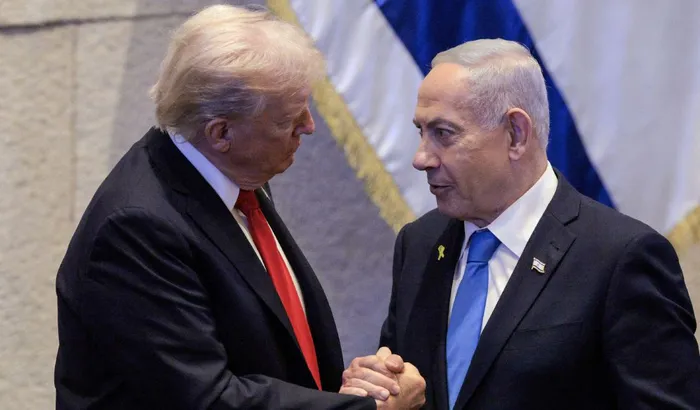
Israeli Prime Minister Benjamin Netanyahu convinced US President Donald Trump to mount a joint attack on Iran by promising a quick coup in the country, the New York Times reported on Sunday, citing anonymous sources.
Image: Chip Somodevilla | AFP
In a proverbial "led by the nose" scenario that saw Trump completely controlled and dominated by Netanyahu, lacking independent thought. The result: Trump acted against America's best interest by falling for Israel’s plot.
The New York Times report reveals that Netanyahu appears to have convinced Trump about the possibility of regime change in Iran by playing "a brief video that included a montage of potential new leaders who could take over the country if the hard-line government fell."
The report added: "Mr. Netanyahu and his team outlined conditions they portrayed as pointing to near-certain victory: Iran’s ballistic missile program could be destroyed in a few weeks. The regime would be so weakened that it could not choke off the Strait of Hormuz, and the likelihood that Iran would land blows against U.S. interests in neighboring countries was assessed as minimal. "Interestingly, the revelations are drawn from a forthcoming book by the authors of the NYT report.
Maggie Haberman and Jonathan Swan.
Titled Regime Change: Inside the Imperial Presidency of Donald Trump, the book promises to be a riveting, intimate, and revelatory account of the Trump presidency, according to Amazon.
Getting back to the report, we learn that Netanyahu met with Trump and his team in the White House Situation Room, which was rarely used for in-person meetings with foreign leaders.
"Mr. Trump sat down, but not in his usual position at the head of the room’s mahogany conference table. Instead, the president took a seat on one side, facing the large screens mounted along the wall. Mr. Netanyahu sat on the other side, directly opposite the president.
"Appearing on the screen behind the prime minister was David Barnea, the director of Mossad, Israel’s foreign intelligence agency, as well as Israeli military officials. Arrayed visually behind Mr. Netanyahu, they created the image of a wartime leader surrounded by his team."
Exactly seventeen days before the launch of the February 28th joint US/Israel war against Iran, Netanyahu misled Trump by assuring him that "Iran was ripe for regime change" and insisted that a joint U.S.-Israeli mission could finally "bring an end to the Islamic Republic."
Though the world has now learned after 40 days of war, which saw thousands of US/Israeli missiles raining down on Iran, that the Islamic Republic not only withstood the blows but also inflicted heavy losses on Israel and US military bases across the Gulf monarchies.
At the time of Netanyahu's malicious plotting, he outlined conditions portrayed as pointing to near-certain victory: "Iran’s ballistic missile program could be destroyed in a few weeks. The regime would be so weakened that it could not choke off the Strait of Hormuz, and the likelihood that Iran would land blows against U.S. interests in neighboring countries was assessed as minimal."
To emphasise his argument, Netanyahu shared Mossad’s intelligence, which indicated that "street protests inside Iran would begin again and — with the impetus of the Israeli spy agency helping to foment riots and rebellion — an intense bombing campaign could foster the conditions for the Iranian opposition to overthrow the regime".
To further convince Trump, the report reveals that Netanyahu raised the prospect of Iranian Kurdish fighters crossing the border from Iraq to open a ground front in the northwest, stretching the regime’s forces and accelerating its collapse.
In a follow-up meeting held by Trump, his inner circle, and his intelligence team—excluding Netanyahu - the CIA director Ratcliffe used one word to describe Netanyahu’s regime change scenarios: “farcical.”
At that point, Mr. Rubio cut in. “In other words, it’s bullshit,” he said.
In his assessment, General Caine made a number of damning remarks about what he believed to be standard operating procedure for the Israelis. "They oversell, and their plans are not always well-developed. They know they need us, and that’s why they’re hard-selling.”
And in contrast to Netanyahu’s hard sell, Caine "flagged the enormous difficulty of securing the Strait of Hormuz and the risks of Iran blocking it."
Hegseth didn't share Caine's reservations. He bought Netanyahu's line and turned out to be the biggest proponent of a military campaign against Iran.
But as for Vance, he warned Trump that a war against Iran "could cause regional chaos and untold numbers of casualties." It could also break apart Mr. Trump’s political coalition and would be seen as a betrayal by many voters who had bought into the promise of no new wars.''
While Kushner and Witkoff were engaged in talks with Iranian officials in Geneva, Netanyahu kept piling pressure on Trump, urging him to "move fast."
As it turned out, Trump paid scant regard to the dissenting voices in his inner circle and instead fell for Netanyahu's fake promises by issuing the following order: “Operation Epic Fury is approved. No aborts. Good luck.”
History will record Trump's assumption, based on Netanyahu’s assurances that Iran would capitulate in a quick war, was not only a foolish error of judgment but also that the consequences have been disastrous for his erratic presidency.
Jassat is an executive member at Media Review Network