

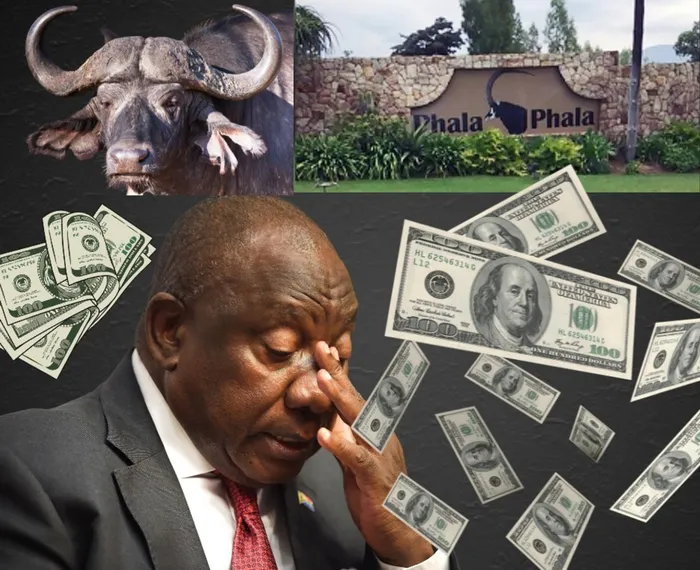
South Africa's political landscape is marred by an intricate performance of accountability, evident in the Phala Phala scandal, says the writer.
Image: IOL graphics
South Africa has not failed to build systems of accountability. It has perfected the art of staging them. A scandal erupts. The curtain rises. Panels are convened, mandates drafted, and evidence assembled. The language is careful, the choreography precise. The audience leans in. Then, just before the final act, the production ends. No verdict. No consequence. The set is cleared. The actors exit. The system resets. Phala Phala is not a deviation from this pattern. It is one of its clearest performances.
The Section 89 panel did not fail. It did exactly what it was designed to do. It tested the facts, interrogated the explanations, and reached a threshold conclusion: there was prima facie evidence that President Cyril Ramaphosa may have committed serious violations and misconduct. That is not ambiguity. It is an institutional signal.
But in South Africa’s accountability architecture, signals are not designed to produce consequences. They are designed to trigger a process. The next act belonged to Parliament.
And here, the system revealed its logic with precision. A vote was held. 214 MPs opposed an impeachment inquiry. 148 supported it. The requirement was procedural. The outcome was political. The form was satisfied. Substance was deferred. This is often described as institutional weakness. It is something more deliberate. South Africa does not suffer from a lack of rules. It suffers from their proliferation.
Each additional mechanism, each layer of review, diffuses responsibility rather than concentrating it. Accountability is not eliminated. It is distributed so widely that no single institution is forced to carry it to conclusion.
This is not failure. It is designed. Seen this way, Phala Phala is a compressed version of a longer script. The same structure defined the aftermath of the Zondo Commission: a definitive account of how the state was repurposed for private extraction, followed by a slow, fragmented translation into consequences. Revelation was decisive.
Resolution was optional. Phala Phala accelerates the sequence but preserves the outcome. Strip away the procedural layering, and the underlying problem is stark. A large sum of foreign currency was held at the sitting president’s private farm. A theft occurred.
Their response did not follow ordinary policing channels. Instead, it moved through a greyzone where presidential protection, private interest, and informal authority converged.
That convergence is not incidental. It is a test of the boundary between public power and private interest. Presidential security exists to protect the office. When it is deployed in response to a private loss, that boundary does not simply blur. It is actively renegotiated. Authority continues to operate, but without a stable legal footing.
Decisions are taken, but the chain of authorisation becomes opaque. Not outside the system. Inside it. The question is no longer whether rules were broken in a narrow sense. It is whether the system can meaningfully act when power operates in this ambiguous space between the formal and the informal. The institutions did respond.
The Section 89 panel identified inconsistencies, disclosure gaps, and areas where conduct may have crossed constitutional lines. Other bodies addressed narrower questions. The South African Reserve Bank, for example, did not find a breach of exchange control regulations on the available evidence.
But this fragmentation is not incidental. It is functional. Each institution resolves a fragment. None is required to resolve the whole. Legal exposure is separated from political judgment. Procedural thresholds substitute for substantive evaluation. The system moves, but it does not converge. This is how accountability is absorbed.
Pressure builds. Process expands to contain it. Legitimacy is performed through visible activity. Then the pressure is released without a decisive endpoint. The system does not break under strain. It metabolises it. Everything functions. Nothing concludes. The risk is not that Ramaphosa remains in office.
Democracies can absorb contested leaders. The bigger risk is that this pattern becomes the expectation. That scandals are no longer resolved but managed. That accountability is no longer understood as an outcome but as a sequence. Over time, the question shifts. Not what will happen, but what is the next step?
This is how erosion occurs in functioning democracies. Not through collapse but through indefinite deferral. Not through the absence of institutions, but through their overperformance without closure. What would disrupt this equilibrium is not another inquiry. It is finality. Finality is structurally different from process. It forces a system to produce a binary outcome where ambiguity can no longer be sustained. A president under oath.
A forum with consequences. A parliamentary decision that compels alignment between principle and action. Finality is the last act the system avoids staging. Because it imposes cost. It fixes responsibility. It collapses the distance between what institutions say and what they do. Theatre allows that distance to remain. South Africa’s accountability architecture is not hollow. It is active, sophisticated, and responsive. But it is calibrated to stop just short of consequence.
Phala Phala does not expose a failure to investigate power. It exposes a system that can investigate indefinitely without ever being forced to decide. That is the equilibrium. And until it is broken, accountability in South Africa will remain something the system performs, not something it delivers.
Qwesha is a trade finance consultant with expertise in global commerce and risk management and regularly contributes to a number of publications