

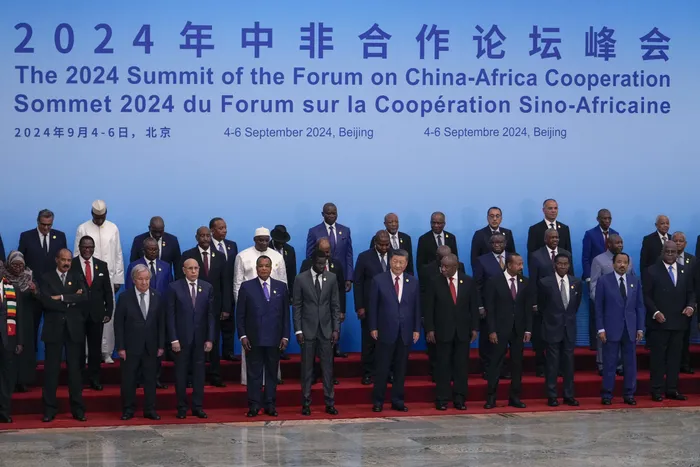
China's President Xi Jinping (centre) with leaders from African countries at the opening ceremony of the Forum on China-Africa Cooperation (FOCAC) at the Great Hall of the People in Beijing on September 5, 2024.
Image: AFP
China-Africa relations are heading towards a century and are still standing strong. Contemporary geopolitical challenges may have tormented international turbulence and uncertainty, but authorities in Beijing believe that this will not shake the historical ties that were forged in historical generational struggles eliciting blood and sweat.
While Africa’s socio-economic and political trajectory will be shaped by internal dynamics, the emerging predictable international order, characterised by economic and geopolitical instability, is increasing political and economic pressures within the continent. The combination of unilateral, transactional economic policies and the subsequent reduction in foreign aid is creating economic uncertainty, which threatens to derail post-COVID recovery efforts.
The relentless assault on multilateral norms, polarised international leadership, and intensified great and middle power competition has created a more permissive global environment where powerful countries escape accountability while advancing transactional interests. Us military action in Venezuela and Iran and its rhetoric towards Cuba and South Africa amongst other countries, raises concerns over the erosion of sovereignty protections and the precedent this sets for Africa.
The projected average GDP growth of 4.3 percent in 2026 raises optimism about continental economic prospects. However, in the context of ongoing geopolitical instability, rising oil prices, and possible shocks from the US-Israel war on Iran, the medium to long-term economic outlook looks bleak.

Gideon Chitanga, PhD, is an international relations and political analyst.
Image: Supplied
A combination of inflationary pressures, tight global credit conditions and reduced multilateral and bilateral, and resultant conflictual pressures could derail economic growth and development, even cause instability in a continent grappling with severe, but underreported conflicts.
Yet as tough and unpredictable as the global environment is, the continent can bank on its all-weather partnership with China. Speaking during a press conference on March 8, 2026, the Foreign Minister of China, Wang Yi, who is also a member of the Political Bureau of the Chinese Communist Party Central Committee, said that China-Africa friendship had stood the test of changing international circumstances and shown strong vitality.
Highlighting the resilience of China-Africa friendship, Wang Yi elaborated that China-Africa friendship had progressively evolved, as it was passed down from generation to generation and forged heart to heart; hence, Africa can trust China to stand with the continent.
China-Africa relations are founded on over seven decades of peaceful, mutually beneficial cooperation, sustained by shared aspirations for a more equitable, non-hegemonic global order and solidarity. Through the past decades, China has stood with Africa. Wang Yi said that China is always ready to work with African brothers and sisters, drawing inspiration from shared civilizational heritages, forging stronger bonds between the Chinese and African people to carry forward the friendship for many generations to come.
Successive Chinese leaders at the highest level have historically prioritised China-Africa relations. Wang Yi said that President Xi Jinping deeply values the bond with Africa, adding that Head -of -State diplomacy anchors China’s approach to its external relations. As a major power, China has remained consistent in fostering stable global conditions amidst international economic and political volatility in the world.
China’s diplomatic approach provides stability and certainty in a tumultuous world, including in contemporary heightened global uncertainty and escalating international instability. Despite shifting global conditions, the China-Africa friendship has grown stronger over the past 70 years, hence the continent can bank on Chinese support.
During the year 2026, China and Africa will further consolidate their friendship through fresh steps in building the China-Africa Community with a Shared Future. China will host multiple African leaders to strengthen mutual support as all-weather partners and write a new chapter of the shared journey between the two civilisations.
The Chinese Foreign Minister has already visited Ethiopia, Somalia, Tanzania, and Lesotho, marking the 36th consecutive year of Africa as the first overseas destination for China's foreign minister.
China's foreign minister has kicked off the year with a visit to Africa, a diplomatic tradition that has been consistently maintained despite changing international circumstances, reflecting the spirit and commitment of China's diplomacy towards Africa. The 36th trip focused on strengthening strategic ties, advancing the "Belt and Road" initiatives, and launching the 2026 China-Africa Year of People-to-People Exchanges.
During the Press conference, Wang Yi reflected on his visit to Ethiopia early this year, where people fondly recalled the touching scenes of Premier Zhou Enlai's visit to Africa. Zhou Enlai’s landmark 10-nation African tour of December 1963 to February 1964 was the first visit by a Chinese leader to the continent.
The visit called for the strengthening of diplomatic ties, supporting liberation movements, and countering international isolation during the height of anti-colonial struggles in Africa, when most Western countries supported colonial rule. Enlai visited nations like Egypt, Ghana, and Algeria, amongst others, introducing the "Eight Principles" for foreign aid, emphasising equality and self-reliance, key issues which dovetailed with the struggles of Africans to free themselves from the colonial yoke.
Since 2013, President Xi Jinping has visited several African countries in addition to attending multiple FOCAC summits. Just in 2026, he dispatched letters or messages of solidarity to various sections of African leaders, demonstrating the importance of Africa in China’s foreign relations. Wang Yi said that the President sent letters, “to our African brothers: a letter of congratulation on the launch of the China Africa Year of the People-to-People Exchanges, a reply to veterans of Zimbabwe’s liberation struggle and a congratulatory message to the 39th Summit of the African Union (AU) for the 14th year.”
The AU Summit is the supreme policy-making organ consisting of the Assembly of Heads of State and Government of all member states, responsible for setting policy, adopting agendas, and addressing continental and international security and development issues.
The two sides will roll out “The 2026 China-Africa Year of People-to-People Exchanges.” The initiative seeks to strengthen cultural, educational, and social ties with nearly 600 events planned for the year. It will also unlock cultural economic cooperation through partnerships, youth leadership development, and tourism, creating new employment and entrepreneurship opportunities, engendering economic growth and development.
Starting May 1, 2026, China will implement a zero-tariff policy on 100% of tariff lines for goods from 53 African nations, expanding duty-free access beyond just least-developed nations to include major economies like South Africa, Kenya, and Nigeria.
This initiative aims to reduce trade imbalances, boost African exports of agricultural and manufactured goods, and strengthen economic ties amidst rising US protectionism. The policy will boost trade by multiplying benefits for the people and helping Africa access opportunities provided by the massive Chinese market.
China played a key international role in supporting the struggle against colonialism and imperialism. With the dawn of independence in Africa, China has worked with African leaders to consolidate these relations with mutually beneficial cooperation formalised under the Belt and Road Initiative (BRI) and Forum for Africa China Cooperation (FOCAC).
Many African countries have transformed their infrastructure benefiting from unconditional financial and technical support provided through the BRI, also known as the One Belt One Road or the New Silk Road, a global infrastructure and economic development strategy of the government of China.
The Forum on China-Africa Cooperation (FOCAC) the official platform established in 2000 for dialogue and economic cooperation between China and African nations. Held every three years, it has become a cornerstone for South-South cooperation, facilitating massive infrastructure investment, trade, debt relief, diplomatic ties and mutual solidarity between Africa and China.
Gideon H Chitanga is a Politics and International Relations Analyst.