
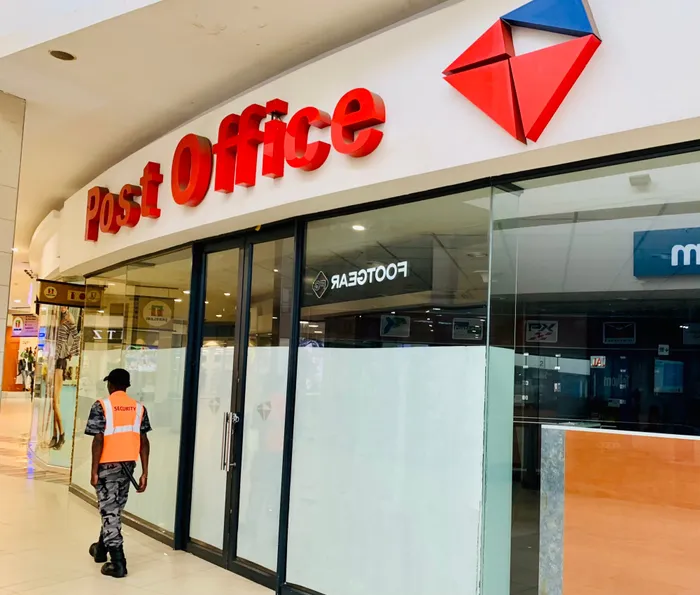
The looming collapse of the South African Post Office poses a grave threat to millions who rely on it for access to vital services, highlighting the urgent need to protect this essential link for marginalised communities, says the writer.
Image: Bhekikhaya Mabaso / Independent Newspapers
On pension day in a small rural town, the queue outside the local branch of the South African Post Office often begins forming before sunrise.
For many residents, the building is more than a place to collect parcels or send letters. It iswhere pensioners access services, where small businesses dispatch goods, andwhere communities maintain one of their few connections to the formal economy.
If the Post Office collapses, millions of South Africans will lose more than a postal service. They will lose one of the last pieces of public infrastructure linking marginalised communities to opportunity.
South Africa now stands dangerously close to making that mistake. As of March 2026, the Post Office’s business rescue practitioners have warnedthat liquidation may become unavoidable because the R3.8 billion required tocomplete the rescue plan has not yet been secured.
The country’s communications minister, Solly Malatsi, has described talk of liquidation aspremature and says discussions with government and the National Treasury arecontinuing.But the fact that such discussions are happening at all reveals how serious thesituation has become.
The future of one of South Africa’s oldest publicinstitutions now depends on whether the state believes the network it built overgenerations is still worth saving.If the Post Office disappears, the consequences will extend far beyond the fateof a struggling state-owned enterprise.
South Africa will lose a piece of nationalinfrastructure that still connects citizens to addresses, deliveries, documentation, government services, and markets.In many rural towns and township communities, the Post Office remains one of the last remaining points of contact between people and the formal economy.
Private logistics companies, quite rationally, concentrate their operations wheredelivery routes are profitable. Banks and digital platforms often struggle tooperate in areas where incomes are low and infrastructure is thin.
Yet these areprecisely the places where affordable logistics, trusted service points, andaccessible infrastructure are most needed.South Africa is already one of the most unequal societies in the world, andgeography continues to shape economic opportunity. Residents of wealthy
metropolitan areas enjoy fast courier services, sophisticated digital platforms,and dense networks of financial institutions.
But in many rural communities andpoorer urban areas, access to those same services remains limited or expensive.
For decades, the Post Office helped fill that gap.Its national network connected communities that commercial markets oftenignored, providing basic delivery services and access points for communication,payments, and documentation.
That network has deteriorated badly in recentyears because of governance failures, financial mismanagement, and the global decline of traditional mail as communication moved online. Hundreds of branches have closed.
The scope of services has been reduced.Public confidence has eroded.Yet despite this decline, the infrastructure itself has not completely disappeared. According to its restructuring plans, the Post Office has already reduced its footprint to roughly 657 active branches after more than 300 permanentclosures.

nyaniso Qwesha
Image: Supplied
The network that remains is smaller and more fragile than it once was,but it still reaches communities that private operators often do not. This is why the debate about the Post Office needs to move beyond thesimplistic choice that often dominates public discussion: either endless bailoutsor liquidation.
That is a false dilemma.The real choice is between reforming a national infrastructure network so that itworks in a modern economy or dismantling it and accepting deeper exclusion asthe result.
The restructuring proposals already being discussed point toward a different future for the institution. Instead of relying on declining letter volumes, the Post Office could reposition itself around last-mile logistics for e-commerce, digitalservice platforms, and branches repurposed as community access hubs.
Such hubs could host a range of services, including government documentation,financial services, digital connectivity, and logistics support for smallbusinesses. Partnerships with private companies could allow the network togenerate revenue through infrastructure leases, shared logistics systems, andmanaged service agreements.
In other words, the future being discussed is not about preserving a nostalgicinstitution. It is about modernising a national network so that it supportsparticipation in a digital and logistics-driven economy.None of this means the Post Office should simply receive more public fundingand continue operating as it has in the past.
Critics are right to demand accountability. Years of weak governance and poor execution contributeddirectly to the crisis the institution now faces.Any further public support must therefore come with strict conditions.
Those conditions should include professional and independent leadership,transparent financial reporting, modern logistics systems, clear performancetargets for branch productivity, and credible partnerships with private firms.Public funding should support infrastructure that expands access, not perpetuateinefficiency.
At the same time, allowing the Post Office to collapse would carryconsequences that are rarely acknowledged in the current debate.
Liquidation would not simply mean the closure of a struggling company. Itwould mean the disappearance of one of the few remaining public networks capable of reaching communities that markets often overlook.
That outcome would send a powerful message about the kind of country SouthAfrica is becoming. It would suggest that if citizens live in places where private markets cannot operate profitably, the state will also withdraw its presence.
For rural households, township entrepreneurs, and digitally excluded citizens,the signal would be clear: participation in the formal economy will depend increasingly on geography and income.That is a dangerous direction for a society already defined by deep inequality.
The argument for saving a reformed Post Office is therefore not aboutsentiment. It is about whether public infrastructure still has a role to play inexpanding opportunity.
If South Africa believes that economic participation should not depend onwhere people live, dismantling one of the few national networks that stillconnects marginalised communities to markets should not be treated as a routinefinancial decision.
The old Post Office cannot be restored. Too much has changed for that. But theinfrastructure that remains could still form the foundation of a modern nationalnetwork supporting digital access, logistics, and economic inclusion.
The real question is not whether the Post Office can survive. It is whether South Africa still believes that economic opportunity should not depend on where people live.
Qwesha is a trade finance consultant with expertise in global commerce and risk management and regularly contributes to a number of publications