
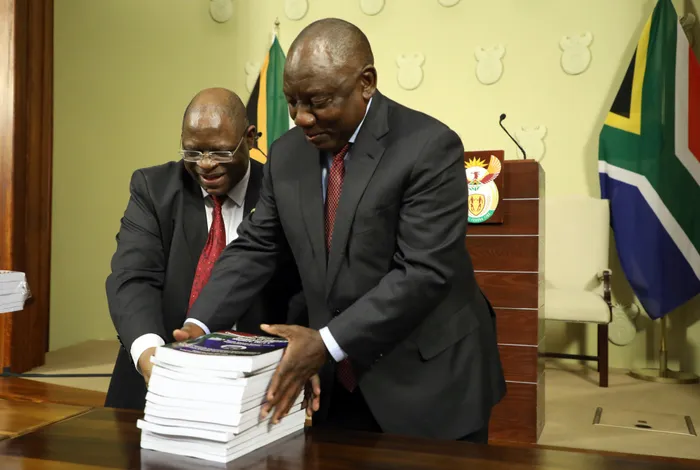
Chief Justice and Commission Chairperson, Judge Raymond Zondo, presents President Cyril Ramaphosa with the report on the Judicial Commission of Inquiry into Allegations of State Capture, Corruption and Fraud in the Public Sector, including Organs of State in 2022. According to the writer, South Africa treated the Zondo inquiry as closure rather than a catalyst.
Image: Supplied
If the dead could rise now, they would not need eyewitnesses. They would only need access to government printers.
The betrayal is no longer whispered. It is bound, footnoted, indexed, and uploaded. It lives in the thousands of pages of the Zondo Commission, the interim findings of the Madlanga Commission, the rituals of parliamentary oversight, and now the Special Investigating Unit’s interim report exposing industrial-scale visa fraud at the Department of Home Affairs. If corruption were electricity, South Africa would not be experiencing load shedding.
Zondo did not merely reveal wrongdoing. It mapped an alternative state. Procurement became extraction. Loyalty replaced competence. Silence became policy. Institutions were not infiltrated. They were redesigned to serve private networks. The country was handed a manual explaining exactly how it had been robbed.
What should have followed was a consequence. What followed instead was theatre.
South Africa treated Zondo as closure rather than a catalyst. Reports were tabled. Press conferences were held. Sombre statements were issued with the gravity usually reserved for funerals. Then the machinery of justice slipped into neutral. Exposure was treated as accountability, as though naming the wound could replace stitching it closed.
Nearly four years after Zondo’s final reports in 2022, the record remains uneasy. The National Prosecuting Authority, under renewed leadership, has restructured and recommitted. Investigating directorates have been made permanent. Task forces integrated. Progress exists, but it is incremental and often imperceptible.
Of the 218 criminal referrals arising from Zondo, roughly a fifth have been enrolled or finalised. Some high-profile cases inch toward trial. A handful of convictions have landed, mostly lower down the food chain, often cushioned by suspended sentences.
Here, we must pause. The instinct is to declare this a failure, and in moral terms it is. But the harder question is why. The post-apartheid justice system was deliberately designed to be slow, deliberate, and protective of the accused. Those safeguards, born of noble intention, now function as insulation for the powerful. Delay becomes defence. Appeals multiply. Dockets age. Witnesses tire. We demand speed from a system built to crawl and then treat its crawling as a conspiracy.
The principal architects of state capture remain largely not behind bars, not because the state lacks truth, but because their legal teams are better resourced than the institutions pursuing them. This is not a defence of delay. It is a diagnosis of its design.
Asset recovery tells a more complex story. More than R16 billion has been clawed back through the SIU, the Asset Forfeiture Unit, and SARS. Billions frozen. Settlements signed. On paper, this looks like momentum.
For communities that wait in queues that lead nowhere, that bury children who might have lived had clinics not been stripped, R16 billion is not abstract. It is medicine. It is classrooms. It is a repair. But it is not justice. And the danger lies in pretending it is.
The temptation is to dismiss asset recovery because it falls short of imprisonment. That would be a mistake. Financial restitution is the accountability of a register that the poor understand intimately. When stolen money returns to build a school, that is a consequence.
The failure lies not in recovery, but in invisibility. Recovered funds disappear into consolidated revenue. The public never sees the clinic rebuilt with looted health budgets. Restitution becomes rumour, and the wound remains open.
Then comes the Madlanga Commission, peeling back a more uncomfortable truth. Corruption did not stop at procurement. It seeped into the criminal justice system itself. Allegations of syndicates within policing, prosecution, and intelligence point not merely to failure, but to internal sabotage. Institutions meant to protect democracy now struggle to enforce it.
As outrage threatens to dull into fatigue, the SIU reminds us that corruption does not only steal billions. It sells borders.
Its interim report on Home Affairs exposes a two-decade racket in which visas, permits, and asylum documents were traded like commodities. Officials, syndicates, and middlemen turned immigration into a cash register. Fraudulent asylum permits were issued, then converted into permanent residency and citizenship. More than 2,000 study visas are now being revoked. South Africa’s sovereignty was not breached. It was invoiced.
This is not administrative rot. It is national security for sale. Borders became profit centres. The state became an accomplice.
The human cost is quieter but enduring. Clinics still lack medicine stolen years ago. Young people wait in queues that lead nowhere. Trust erodes not in moments of scandal, but in daily encounters with systems that do not work. South Africa’s corruption score remains stagnant, below the global average. We are not collapsing. We are stuck.
Mbuli’s question burns because it is unavoidable. What have the sacrifices become?
They have become a democracy where commissions substitute for consequence, where truth accumulates while justice drags, and where accountability is endlessly deferred in the name of caution. But also, a democracy that confuses slow justice with no justice, that dismisses the labour of prosecution as performance, and that refuses to recognise progress because it is imperfect.
The dead did not organise, go into exile, and die so that justice could remain permanently pending. But neither did they die so that anger could replace analysis. They dreamed of a state that worked. Of borders that functioned. Of public servants governed by discipline rather than extraction. They did not imagine a republic addicted to inquiry and allergic to finality.
What must change is not mysterious.
The National Prosecuting Authority must publish clear, enforceable timelines for Zondo-related decisions, with consequences for unjustified delay. Parliament must enable remedies when prosecutorial inaction becomes unreasonable. But speed alone is not justice. Resourcing is. Investigators need capacity, protection, and time that is not endlessly consumed by manufactured delay.
Recovered assets must be visibly returned to the communities from which they were stolen. Announce it. Name it. Cut ribbons over it. Let restitution be seen and felt.
The findings of Zondo, Madlanga, and the SIU must be taught plainly. Names, dates, mechanisms. Forgetting is corruption’s final refuge. But so is cynicism that refuses to mark progress while demanding perfection.
The dead are no longer asking what was revealed. They are watching to see whether it mattered. They are also watching to see whether we have the clarity to recognise consequences when they arrive, even in imperfect form.
They did not die for perfect reports. They died for a country that works. In South Africa today, justice and functionality are inseparable. We will have neither until we risk more than words. And we will have neither until we learn to demand better without pretending that nothing counts.
Qwesha is a trade finance consultant with expertise in global commerce and risk management and regularly contributes to a number of publications