How weapons became part of celebrations: A look at Julius Malema
FOOD FOR THOUGHT
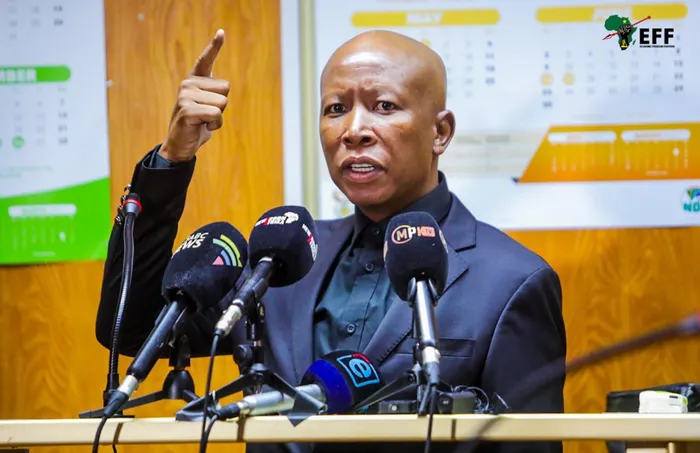
EFF leader Julius Malema will appear in the East London Magistrate’s Court for a pre-sentencing hearing on Friday.
Image: File/ EFF
A social worker, Jessie Thompson, in the case (“illegal firearm discharge”) of Mr Julius Malema, the President of the EFF, explained that in the charge, there was no intent to cause harm…it was a celebration.”
However, the magistrate, Twanet Olivier, questioned whether “anyone who is having a birthday today may walk down Oxford Street, shoot a firearm, and say it is their birthday and they are celebrating…? ”
One should conclude that the magistrate was sarcastic or ignorant or deliberate or wanted clarity. Anyone would know that the usage of weapons during celebrations is not a new phenomenon.
The 21-gun salute is the most obvious and popular one. The custom is linked to the naval tradition, and there are several reasons argued on why it existed. The first would be for the making of noise to do honour to the guest, and the second was the emptying of guns by firing as a gesture.
This was considered a friendly and trusting gesture, as once fired, the guns could not be easily and quickly reloaded; hence, an honour was conferred upon the guest. It was a sign that s/he was trusted and considered an ally or a sign of friendship; it was a signal from naval ships firing their cannons signalling that they had no hostile purposes, that they were disarmed and harmless; it was effected as a sign of respect and honour.
In Serbia, every new year starts with an explosion; people fire guns in the air, while children throw firecrackers. In The Citizen newspaper of the 29th of March, 2025, an article was published titled “UFC Middleweight Champion Fires the Cannon.”
This happened at the Voortrekker Monument in Pretoria. Of course, the natural question that arises is about the material used and whether it was legal or illegal, but this is not my concern, as I intend to show that weaponry has a role in traditional celebrations.
My point is, even in the Voortrekkers celebrations, weapons play a significant role. Africa is not an exception; weapons play a significant, multifaceted role in African celebrations, serving as potent symbols of heritage, social status, and spiritual linking rather than merely as devices of violence.
They are profoundly implanted in the cultural frame, appearing in ceremonies ranging from weddings and initiations to funerals and royal festivals, where they often represent protection, authority, and masculinity.
Among many African tribes, for instance, traditional weapons like battle axes, spears, and shields are prominent at royal events and ceremonies, carried by leaders, and used during rituals to respect ancestors. Weapons like spears, bows, and later, firearms, are used in initiation procedures to imply a switch to manhood.
They symbolise the capability to shield the family and community. It is important to note that because of evolution in Africa, firearms, including muskets and cannons, have been absorbed into African cultural rituals, such as being fired during funerals and other celebrations to mark the event. In many contexts, these items are altered into repute weapons that are, as noted, larger, more ornate, or specially invented to be used in dance or display rather than for warfare, thus aestheticising power.
Perhaps I should now answer this question by Magistrate Olivier when seeking clarity on when a weapon can be used during a celebration: “Just explain the difference then, please, ma’am.” It is important to note that political parties in Africa and elsewhere are militant in nature or have a military posture in anticipation of ruling the country in the future.
Political parties in Africa are by definition militant; therefore, these are organisations seeking to achieve specific ideological, social, or power-based goals, often in direct competition with adversaries.
While not all parties are violent, many embrace a militant posture—defined as a determined, adamant, and highly stimulated stance—to mobilise supporters and influence change. It is for this reason that there are military ranks and structures in political parties, and some receive military training. The culture and language are of military posture, including the songs, slogans, and poems. Anyone who understands this context would therefore not ask, “Anyone who is having a birthday today may walk down Oxford Street, shoot a firearm, and say it is their birthday and they are celebrating…? ”.
It is out of this context that I do not believe that the magistrate believes that Black lives in Mdantsane were in danger or that Malema had any intention to cause harm or be violent against the members of the EFF, except that the magistrate, like many whites, has been waiting patiently to use any opportunity to teach Malema, by default, and blacks a lesson.
BB Senokoane, Associate Professor in the College of Human Sciences, UNISA