

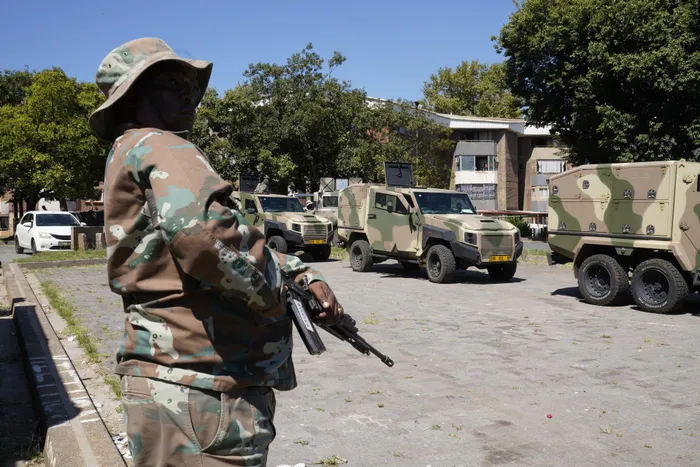
SANDF chief General Maphwanya reassured communities that the soldiers are there to protect them, not to cause harm.
Image: Timothy Bernard / Independent Newspapers
Parliamentarians have said that they are not yet happy with the operational plans of the South African National Defence Force (SANDF) with the South African Police Service (SAPS), but that they expect a forthcoming joint committee meeting will help ease some of their concerns.
This emerged on Thursday during a Peace and Security Cluster briefing by various committee chairpersons, where they discussed and briefed the media on Parliament’s oversight of crime, defence and national security matters.
The Chairperson of the Select Committee on Security and Justice, Jane Mananiso, discussed the deployment of soldiers and gang activity.
On the deployment of soldiers, she explained that different cities have given “different postures and responses” to what they expect out of the SANDF deployment
“For instance, people of Eldorado Park welcome the intervention; however, they want to suggest that this intervention not be only about the deployment for crime issues, but let the governments of provinces look at issues of employment, job opportunities, and to provide psycho-social support.
“So, as committees, that's what we need to follow through. Are the people, who are supposed to be helped after going through the trauma, getting assistance from those departments that need to deliver aftercare?”
She added that they are pleased that after the SONA debate, the SANDF deployment has now been extended to other provinces, including the Eastern Cape, Free State and North West.

The Chairperson of the Select Committee on Security and Justice, Jane Mananiso, discussed the deployment of soldiers and gang activity.
Image: ParliamentRSA/Supplied
Chairperson of the Joint Standing Committee on Defence, Mr Phiroane Phala, said that when the SANDF first briefed the committee, they raised concerns regarding the lack of clarity and alignment between the operational plans of the SANDF and SAPS.
“These concerns included issues around command and control structures, the preparedness of SANDF members to operate in civilian environments, and delays in implementing the Presidential directive. We are therefore pleased that these matters have since been clarified and that there is now greater coordination and cooperation between the SANDF and SAPS,” Phala said.
“South Africa is facing serious criminal challenges that require coordinated action from all sectors of government. The SANDF deployment serves as an important force multiplier in this effort.
“However, it is equally important that clear exit strategies are developed and that the long-term response to crime also includes stronger socio-economic interventions,” Phala said.

Chairperson of the Joint Standing Committee on Defence, Mr Phiroane Phala.
Image: ParliamentRSA/Supplied
When responding to questions, he added that they want things to be done in terms of the law.
“We want them to do things and ensure that they achieve success in their mission. We cannot keep on having them being deployed but with no results.
“We expect this deployment to be different from the previous deployment. We can't be doing this the same,” Phala said.
“Our members of parliament want the SANDF and the SAPS to assist our society and deal with crime, and that is what we'll be looking for.
“We also emphasise to them to explain how they are going to work together. We demanded that they come and present to the members of parliament about their job operations, and that meeting is next week.
“They will come and give us a clear plan on how they are going to work together to ensure that they eradicate crime within our society.”
Chairperson of the Portfolio Committee on Police, Ian Cameron, added: “We're not happy yet. That's why I think it's fantastic that the chair of the Joint Standing Committee has arranged the joint meeting. I think it's an opportunity to make sure that everyone is around the table.”

The Chairperson of the Portfolio Committee on Police, Ian Cameron.
Image: Parliament RSA/Supplied
On gang violence, Mananiso said that gang violence directly affects children who are recruited by gang members and, due to gang violence, are unable to attend school and “often become addicted to drugs, and this is devastating to families”.
“Gang violence requires a multisectoral approach, involving communities, law enforcement and the SANDF to address this scourge of violence head-on and to ensure that our communities are safe. To this end, we will ensure that through our oversight visits and engagement with SAPS and the SANDF through their Annual Performance Plans and budgets, the initiative is set up to dismantle gangsterism and restore families.”
Firearms remain the dominant weapon in murders, which stood at 2 561 murders in the third quarter of 2025/26 and account for 40% of all murders. Firearm-related murders are concentrated in Gauteng at 668, Western Cape with 644 and KZN with 612.
“We need the SAPS to do more in respect of removing and destroying illegal firearms because every illegal firearm removed from communities reduces the chances for murder, robbery and gender-based violence and femicide in our communities,” Mananiso said. “Communities themselves also have a role to play in reporting and handing over illegal firearms to the police.”