
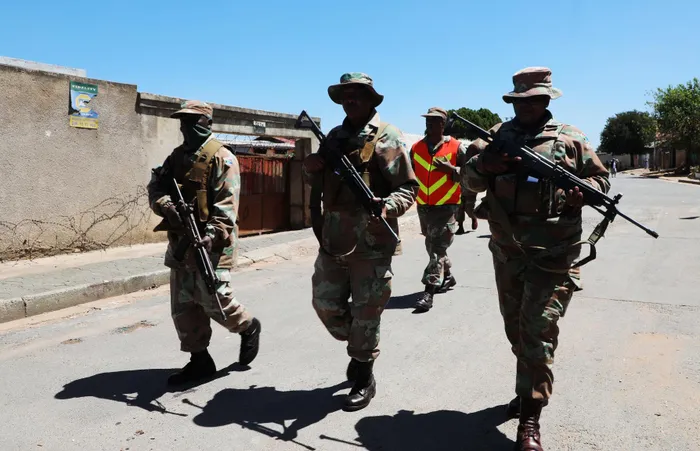
Experts believe the letter by Ian Cameron, the chairperson of the Portfolio Committee on Police, is a sign that the deployment of the South African National Defence Force (SANDF) in Johannesburg is unlikely to be successful.
Image: Timothy Bernard Independent Newspapers
The letter written by the chairperson of the Parliament Portfolio Committee on Police, Ian Cameron, who demanded that the National Police Commissioner, Fannie Masemola, to provide a detailed briefing on the legal basis, command structure, and the specific operational framework following the deployment of the South African National Defence Force in some areas of Johannesburg, shows that there is no proper engagement and consultations between the parties.
This is according to security expert Andy Mashaile, who said the letter also shows that there are serious issues that should be addressed.
This is after soldiers descended on the streets of Johannesburg on Wednesday - a month after President Cyril Ramaphosa, in his State of the Nation Address on February 12, announced the deployment of the army to support the SAPS in a targeted offensive against organised crime, gang violence, and illegal mining in Gauteng, Western Cape and the Eastern Cape. This deployment, known as Operation Prosper, was officially launched in Gauteng on March 11 2026, and is expected to run until March 31, 2027.
On Wednesday, troops touched down on the streets of Eldorado Park, a working-class suburb in the country’s economic capital, Johannesburg, that has high levels of crime and gang violence.
However, in his letter, Cameron said Masemola must explain what legal authority was given before the troops touched down in the streets of Johannesburg.
Cameron, who was concerned about the apparent absence of visible SAPS members accompanying these deployments, also wanted to know whether this deployment is part of the security interventions referenced during the State of the Nation Address, or linked to an extension or repurposing of the existing SANDF deployment previously authorised for illegal mining operations.
He also wanted to know under whose operational command SANDF members are functioning in this instance, and how the command relationship with SAPS is structured.
"What rules of engagement have been issued to SANDF members operating in civilian environments in these areas?" he asked.
Masemola was given 24 hours to clarify the matter.
Asked if Masemola received the letter and his thoughts about it, SAPS spokesperson Athlenda Mathe provided a letter written by Ramaphosa informing the Speaker of the National Assembly, Thoko Didiza, about the deployment of soldiers in Gauteng
The letter, issued on March 5, stated that the soldiers have been deployed under “Operation Prosper-illegal mining”.
The employment is authorised in accordance with the provisions of section 201(2) (a) of the Constitution, while the expenditure expected to be incurred amounts to R80 million.
Mashaile said this will also make it difficult for communities to accept the presence of soldiers in their areas, adding that the mission is unlikely to be successful.
He added that the fact that Masemola was given 24 hours to explain the operating procedure, speaks about serious reservations from Cameron, adding that this might have an impact on the integrity of the process.
“This will also give the impression that we don’t trust the army. We also saw that the community of Eldorado Park does not have confidence in the army and the experience of 2019 in the Western Cape. If we don’t visit this experience and learn, we will be walking into the unfortunate experiences of 2019,” said Mashaile.
A report by Stellenbosch University, 'Security and Rights: The changing security landscape, oversight, and the responsibility', released in November 2025, found that to maximise effectiveness, early parliamentary involvement is required to ensure forces are equipped for the responsibility to protect goals and to prevent power abuse. In addition, ex-post oversight is necessary to ensure consequence management is applied following any abuse.
The report stated that earlier parliamentary involvement will require legislative amendments or an agreement between the executive and Parliament to involve the Legislature at an earlier stage.
“Such comprehensive parliamentary engagements can be enhanced by more frequent engagements with not only the SANDF, but also an array of external stakeholders such as academia and civil society. Further optimising the use of oversight tools enhances deployment oversight, specifically the use of oversight visits and deeper engagement through special inquiries.”
The report also stated that the guidelines for improved oversight of deployments ultimately depend on political will by both the executive and MPs. This requires transparency and cooperation from the political heads of the military and SANDF leadership, as well as the political will from MPs to engage the SANDF thoroughly and regularly on deployments through the comprehensive use of the parliamentary oversight tools.
manyane.manyane@inl.co.za