
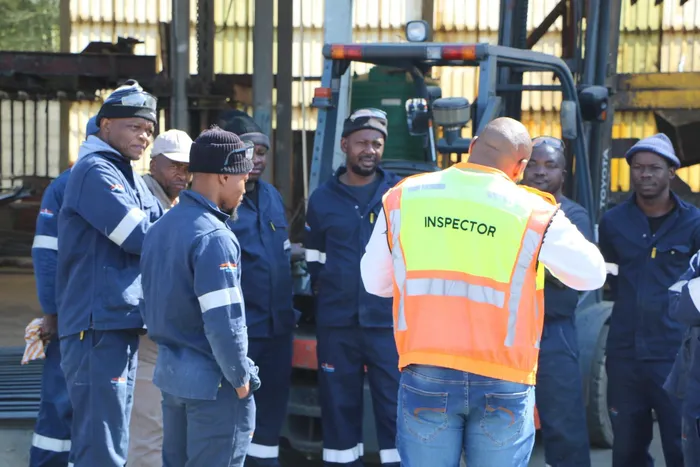
The Department of Employment and Labour aims to enhance workplace enforcement with the addition of 10,000 new inspectors.
Image: Facebook/ Department of Employment and Labour
The announcement by President Cyril Ramaphosa during the State of the Nation Address last month to appoint 10,000 additional labour inspectors comes with substantial financial implications. The estimated total cost for these inspectors is approximately R3.7 billion per year, translating to an estimated R10bn over the medium-term expenditure framework (MTEF).
This came to light after the MK Party’s Adil Nchabeleng submitted a parliamentary question to the Department of Employment and Labour (DEL) minister Nomakhosazana Meth about the planned expansion of the inspectorate.
He questioned the evidence supporting the expansion as an enforcement solution versus potential inefficiency, its full MTEF cost and funding, Cabinet approval for the implementation framework and its tabling, anti-corruption measures, and the timeline/reporting mechanism for measurable impact.
Meth said the estimated cost (salaries and wages) for 10,000 inspectors (warm bodies) is “R3,735,419,652.00 p/a, which would translate into about R10,000,000,000.00 in the Medium-Term Expenditure Framework. This would cover basic salaries, leave pay and gratuities, performance-based allowances and bonuses, statutory contributions (e.g., pension, medical aid), and tools of trade.
“Since it is usually the responsibility of the National Treasury to fund pronouncements made by the President in the State of the Nation Address, it is anticipated that the funding shall be provided by the National Treasury,” Meth said.
She said the project and implementation plan are currently in development, anticipated to be finalised by March 13, 2026. Once complete, they will be tabled internally for approval and next steps.
Meth said the inspectorate’s two decades of work are evident. Administrative data show that only about 2-5% of workplaces were covered by advocacy, inspections, and enforcement during this time.
This is in the context of the following statistics on the number of workplaces:

Minister Nomakhosazana Meth has shared the financial implications of hiring 10,000 labour inspectors.
Image: GCIS
Meth noted that the International Labour Organisation’s guideline for developing economies is one inspector per 10,000 workers. Although South Africa is a developing economy, it is recognised as an upper-middle-class transitioning economy. It has some advanced development but retains features of a developing economy.
“There are approximately 16.8 million people employed in the country. This figure excludes the informal economy and is also likely to exclude some SMMEs. In view of these dynamics, and the fact that there is an increased demand for the services of the DEL, particularly in the regulation of undocumented migrant workers, the additional 10,000 inspectors will significantly improve the operational reach of the inspectorate and make an impact in the South African labour market,” Meth said.
However, DA employment and labour spokesperson and labour lawyer Michael Bagraim said: “Their wish to employ 10,000 inspectors is a pipe dream. Very much like the promise of smart cities and bullet trains.
“Inspectors are currently under-resourced, lacking essential tools like laptops, computers, and vehicles despite requests for proper equipment. They are told there is no budget. Additionally, the existing team lacks a clear functional focus and has not been structured according to individual abilities.
“It would be wise to first capacitate the staff that they have before they go out and recruit others,” Bagraim said.
“In light of the lack of a budget, it is specifically pointed out that they now intend to spend hundreds of millions of rands on recruiting, training and capacitating new inspectors. They do not have the money, and this money was not targeted in the budget this year.”
Bagraim said that in these circumstances, Cabinet approval should be seen as a dream as opposed to an activity on the ground.
He said training 10,000 inspectors is impossible, as the Department of Employment and Labour lacks the necessary capacity, ability, resources, and strength.
thobeka.ngema@inl.co.za