

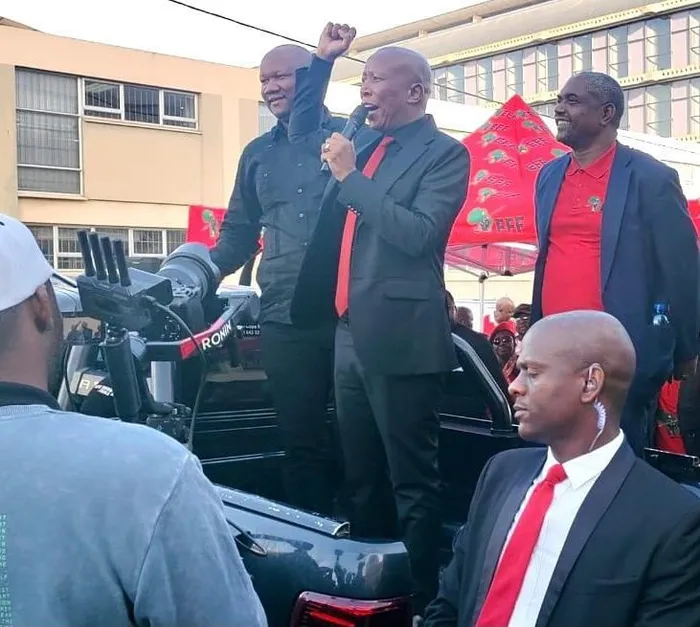
Julius Malema following his sentencing for discharging a firearm. Julius Malema's exercising his right to appeal his sentence is not an act of defiance, but rather an invocation of the very legal safeguards that underpin our constitutional order, writes Godrich Gardee.
Image: Abongile Ginya / Isolezwe lesiXhosa
Throughout my life, spanning both pre- and post-1994 South Africa, I have witnessed our criminal justice system operate at its highest ethical standards and fall to its deepest points of compromise. It may be surprising that I refer to highest ethical standards pre-94, that is, a discussion of another day. The sentencing of EFF President, Julius Malema, on April 16, 2026, arising from the 2018 Mdantsane alleged firearm-discharge incident, regrettably falls within the latter category; the deepest point of compromise.
The imposition of a custodial sentence, despite the defence presenting a compelling and substantiated case for a non-custodial sanction, is, with respect, not only disproportionate but difficult to reconcile with established legal principles. This sentencing hearing stems from a flawed conviction; it is nothing short of the proverbial fruit of the poisonous tree.
The court accepted that no person sustained injury, nor was any individual placed in actual, as opposed to speculative, danger. The discharge occurred during a political gathering characterised by a celebratory atmosphere. There was no evidence that President Malema wielded the alleged firearm in a threatening or menacing manner. Rather, the conduct was presented as symbolic, consistent with a long-standing political tradition in which performative acts are employed to convey defiance and mobilisation.
The defence team, comprising Tembeka Ngcukaitobi SC and Laurance Hodes SC, sharply and authoritatively placed before the court a comprehensive body of evidence, including a detailed pre-sentencing report, expert testimony concerning the sociological dynamics of political assemblies, and authoritative jurisprudence distinguishing recklessness from mere negligence. It was persuasively demonstrated that, if any culpability were to be attributed, it resided at the lowest end of the spectrum of mens rea.
Moreover, comparative jurisprudence reveals that, in cases where no harm has ensued, courts have consistently imposed fines, suspended sentences, or community-based sanctions. The submissions advanced by the defence were not grounded in sentiment, but in the well-established triad of case law and sentencing considerations, namely, the nature of the offence, the personal circumstances of the offender, and the interests of society. Despite mitigating factors and a well-reasoned body of jurisprudence, the court handed down a direct prison sentence, a move that has stunned the community and sparked calls for an urgent appeal against both convictions and sentence.
The concerns are compounded by the procedural and substantive anomalies evident in the treatment of the co-accused, Mr Snyman, a white man before a white magistrate. The acquittal of the second accused on all charges is not accompanied by a cogent or coherent legal rationale in view of the fact that the same court declined his section 174 discharge application. On the State’s own version, the evidentiary matrix implicating both accused was materially indistinguishable.
The alleged firearm belonged to Mr Snyman, while Mr Malema was alleged to have discharged it. In circumstances where the court found insufficient basis to sustain a conviction against the alleged licensed owner of the gun, it is jurisprudentially incongruous that the alleged user should bear full criminal liability.
This internal inconsistency within the judgment raises legitimate concerns regarding the uniform application of legal principles. The selective attribution of liability undermines the integrity of the adjudicative process and risks eroding public confidence in the judiciary far more profoundly than the sentence itself.
It is not far-fetched to conclude that this verdict and sentence resonate with the American President’s public demands for the incarceration of the EFF President; if anything to the contrary, it confirms the clamour of racist whites in South Africa to shut down the lone voice of Pan Africanism for the return of the land to the indigenous people of South Africa.
It is an established principle in law that in a criminal case, for the slightest doubt, the court is duty-bound to accept the version of the accused. Any evidentiary uncertainty must be adjudicated in the manner most beneficial to the accused. In the absence of the co-conspirator (gun owner) and the instrument of crime (the gun) from the courtroom, the version of the accused is the only version. The magistrate failed dismally to rise to the occasion and embrace the sacrosanct doctrine of judicial adjudication.
Equally troubling is the State’s decision to return the firearm to Mr Snyman beforethe delivery of judgment. Within the framework of South African criminal procedure, the disposition of exhibits, particularly firearms, is a matter reserved for judicial determination upon conclusion of the trial where a conviction has been secured. The fact that the presiding officer herself expressed surprise upon learning of this development underscores the irregularity.
The premature release of the firearm occurred while the matter remained sub judice. No formal application was brought, no reasons were tendered, and no explanatory correspondence was furnished to the court despite repeated requests. This raises serious questions regarding the handling of evidentiary material by the prosecution. If the firearm was indeed central to a serious offence, its release is inexplicable. Conversely, if it was not, the persistence in seeking a custodial sentence against the EFF President alone becomes equally difficult to justify.
Such inconsistencies inevitably give rise to the perception that the prosecutorial process was neither even-handed nor guided solely by objective legal considerations.
It may be reasonably inferred that the prosecution possessed advance knowledge regarding the nature of the verdict. Acting upon such knowledge, the prosecution issued directives to the SAP 13 personnel to present the firearm in court and prematurely advised the owner of the gun to retrieve the exhibit prior to the formal pronouncement of the judgment. That would be scandalous to say the least.
This perception is further reinforced when contrasted with the well-documented challenges faced by the National Prosecuting Authority in securing convictions in cases involving violent crime, including murder, rape, and armed robbery. The disparity in prosecutorial vigour is stark and troubling.
The broader political context cannot be ignored. Organisations such as AfriForum have openly articulated a strategy of utilising litigation as a means of engaging political opponents. While litigation is a legitimate tool within a constitutional democracy, its instrumentalisation for political ends raises complex questions about fairness and the proper limits of legal process.
Historical experience further cautions against complacency. Figures such as Patrice Lumumba, Thomas Sankara, and Steve Biko were not undone through overtly unlawful means alone, but through systems that failed to protect dissenting voices. While South Africa’s constitutional democracy provides significantly stronger safeguards, the selective or inconsistent application of the law remains a matter of legitimate concern.
The AfriForum and all white capital-funded NGOs did not open criminal cases against the white Afrikaners who caused an unprecedented commotion in Senekal, last seen when the right-wing Afrikaners tried to invade the then Bophuthatswana to scuttle the coming of the 1994 new dawn.
It bears emphasis that President Malema will exercise his undoubted right to appeal the sentence up to the highest court of the land. This is not an act of defiance, but rather an invocation of the very legal safeguards that underpin our constitutional order. The EFF’s support for this matter is rooted in legal principles, specifically regarding fairness, proportionality, and consistency in sentencing.
Moments of this nature demand both legal clarity and certainty, thus institutional integrity.
The EFF remains steadfast in its commitment to constitutionalism, accountability, and justice. The pursuit of these principles requires not only vigilance, but an unfaltering insistence that the law be applied evenly, rationally, and without fear or favour.
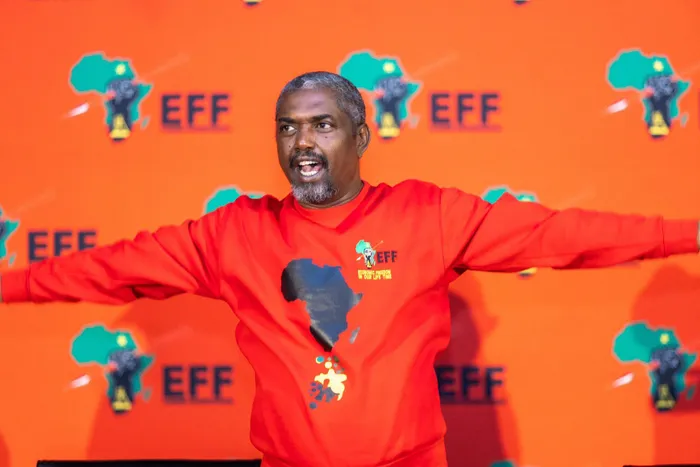
Julius Malema's exercising his right to appeal his sentence is not an act of defiance, but rather an invocation of the very legal safeguards that underpin our constitutional order, writes Godrich Gardee.
Image: X / @EFFSouthAfrica
* Godrich Gardee is Deputy President of the EFF and an admitted attorney of the High Court.
** The views expressed do not necessarily reflect the views of IOL or Independent Media.