

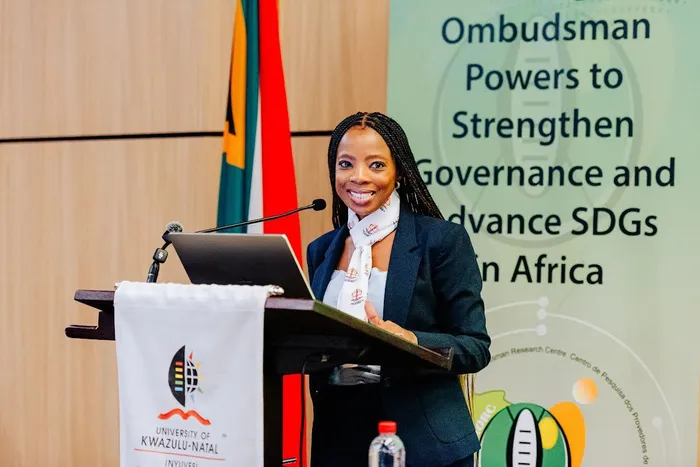
Speaking at the 12th African Federation of Institutes of Internal Auditors Conference in Cape Town, Kholeka Gcaleka said accountability systems must work together to combat corruption and maladministration effectively.
Image: Supplied
Public Protector Kholeka Gcaleka has urged auditors to become the first line of defence against corruption, warning that corruption in South Africa has evolved into a coordinated system that infiltrates institutions through irregular appointments, procurement manipulation, and weakened governance structures.
Speaking at the 12th African Federation of Institutes of Internal Auditors Conference in Cape Town on Monday, Gcaleka said auditors had a critical role in preventing corruption before public resources are lost and state institutions are damaged.
She said corruption continued to place a heavy burden on the African continent, estimating that it costs Africa about US$148 billion (R2.42 trillion).
“Corruption continues to cost Africa, an estimated US$148 billion,” Gcaleka said.
She said the problem remained widespread across many institutions and countries, with budget leakages, fiscal losses, procurement irregularities, irregular appointments, asset misappropriation, and the abuse of public resources continuing to persist.
Gcaleka said South Africa’s experience had shown that corruption was not simply isolated misconduct by individuals but rather a coordinated network operating inside institutions.
“What we've actually picked up in South Africa is that corruption is a system. It's not just a single improper conduct, but it's a system.
''It's a well-orchestrated system which starts off with irregular appointments because that irregular appointment is going to serve those who want irregularities within the system,” she said.
She said this often progressed into irregular procurement practices, maladministration, and the weakening of governance systems, ultimately creating conditions that allowed corruption to thrive.
Gcaleka said approximately a third of the cases investigated by her office involved maladministration, financial misconduct, procurement irregularities, and irregular appointments, many of which were linked to corruption.
“What we find the most is that there is an ecosystem that exists within institutions that enables corruption,” she said.
She warned that corruption often extended beyond accounting officers and involved a wider network within institutions.
“Supply chain management practitioners are crucial in this ecosystem. It becomes worse if auditors turn a blind eye because internal auditors, it is with you that the oversight of accountability really begins.”
Gcaleka said constitutional institutions such as the Public Protector often intervened after the damage had already occurred, placing greater importance on prevention.
“By the time we come in as constitutional institutions, the damage would have already been done. But you've got the power to stop it before it translates into a leak,” she said.
She stressed that accountability required cooperation between institutions and could not be addressed in isolation.
“Accountability is an ecosystem, and we must ask ourselves, how best do we strengthen this ecosystem?” she said.
Gcaleka also focused on the risks faced by whistleblowers, saying many individuals who exposed wrongdoing became vulnerable and often faced retaliation with little immediate support.
“It is not easy to stand against the system of corruption,” she said.
She said the Public Protector’s office had never leaked the identity of whistleblowers or anonymous complainants and considered itself a safe platform for those reporting wrongdoing.
“Our approach, not just to whistleblowers, but also to anonymous complainants, is that we have never leaked a name of a whistleblower or an anonymous complainant. So we are a safe space,” she said.
Gcaleka said some of the office’s investigations had stemmed from information provided by internal auditors, whom she thanked for their courage.
She said amendments currently being processed to South Africa’s legislation, including changes to the Protected Disclosures Act and the Public Protector Act, sought stronger support mechanisms for whistleblowers.
According to Gcaleka, proposed changes included financial support, legal assistance, physical protection, and measures to immediately stop retaliation against whistleblowers and their families.
She also stressed the need to strengthen internal auditing functions within institutions, describing internal auditors as an organisation’s “own conscience”.
“It is the institution's own conscience, the internal mirror, that when functioning properly, shows the organisation what it actually looks like, rather than what it wishes to appear like,” she said.
Gcaleka said internal auditors served as a “leading indicator” because they worked continuously within institutions and had direct access to systems and transactions as they occurred.
“Internal audit prevents, and there’s nothing as important as being preventative,” she said.
She added that as governments increasingly adopt digital systems and artificial intelligence, institutions would also need to focus on ensuring ethical and accountable use of technology.
IOL Politics