

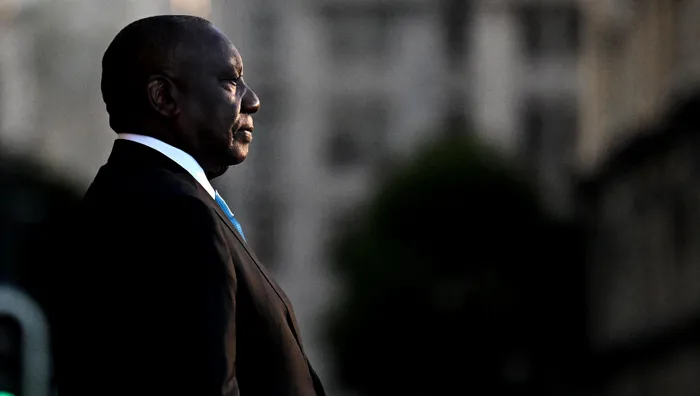
South Africa’s Constitutional Court is set to deliver a pivotal judgment in the long-running Phala Phala saga on Friday.
Image: Phando Jikelo / RSA Parliament
The system is likely to protect President Cyril Ramaphosa on the Phala Phala matter. This is according to political analysts, ahead of the Constitutional Court’s long-awaited judgment on the Economic Freedom Fighters’ (EFF) bid to revive the case on Friday.
The apex court confirmed the date on Tuesday afternoon.
“Kindly be informed that the judgment in this matter will be handed down at the Constitutional Court on Friday, 08 May 2026 at 10h00,” Chief Registrar Simoné-Lanique Tjamela said.
Last month, IOL News reported that the Constitutional Court was in the final stages of preparing its highly anticipated judgment in the Phala Phala matter, a case that has drawn significant public attention since allegations emerged following a burglary at Ramaphosa’s Limpopo farm.
Tjamela had previously indicated that the judgment would be delivered within a month.
The incident dates back to February 2020, when approximately $580,000—about R8 million at the time—was allegedly stolen from a sofa during a break-in at the farm.
The EFF has repeatedly criticised the delay, arguing that it far exceeds the judiciary’s guideline that judgments should generally be delivered within three months unless exceptional circumstances apply.
The party has also staged protests outside the Constitutional Court.
The case, heard on November 26, 2024, centres on the EFF’s attempt to revive the Phala Phala saga.
The party approached the court to challenge Parliament’s December 2022 decision not to adopt the Section 89 panel report, which found that Ramaphosa may have had a case to answer.
The protests followed a letter from EFF leader Julius Malema to Chief Justice Mandisa Maya demanding clarity on what the party described as an “unacceptable delay”.
Malema warned that the prolonged wait risked eroding public confidence in the judiciary and weakening constitutional accountability.
At the heart of the dispute is the case Economic Freedom Fighters v Speaker of the National Assembly and Others, which examines how Parliament handled the Phala Phala matter.
Speaking to IOL News ahead of Friday's ruling, political commentator and author of No White Lies, Kim Heller, said it was highly unlikely that Parliament’s rejection of the Section 89 findings would be overturned by the Constitutional Court.
“The court is unlikely to challenge the decision of the parliamentary majority.”
“Unfortunately, this is a case of how accountability can stray away from constitutional principles and bend to political power and the protection of political elites,” she said.
Heller argued that Ramaphosa was likely to be shielded from accountability even if the EFF succeeded.
“Even in the unlikely event of a legal victory for the EFF, this victory will be more procedural than judicial. The system is likely to protect Ramaphosa from removal or from serious charges,” she said.
Addressing criticism over the delay in delivering judgment, Heller said, “Justice delayed is justice denied. There is a perception that the judiciary moves at a snail’s pace to protect those at the top.”
Meanwhile, the Independent Police Investigative Directorate’s (IPID) report into the Phala Phala robbery found evidence suggesting a cover-up by members of the Presidential Protection Service rather than a properly handled criminal investigation.
The report identified Major General Wally Rhoode and Constable H.H. Rekhoto as central figures. According to IPID, they failed to open an official case, did not report the crime through proper SAPS channels and instead conducted an unauthorised, off-the-books investigation.
Heller said she did not expect the Constitutional Court to act on the report’s findings.
“I believe that the Constitutional Court will downplay the substance of the IPID report and reduce these findings to procedural issues to avoid addressing the grave allegations against the president,” she said.
Another political analyst, Professor Ntsikeleko Breakfast, described the pending judgment as critically important because the Constitutional Court is the final arbiter on constitutional matters.
“After the Constitutional Court’s ruling, there will be no other avenue to explore this matter unless new evidence emerges,” he said.
Breakfast said there were two possible outcomes.
“Either the president emerges as someone who suffered political persecution over a politically motivated matter, or this reinforces the thesis that he has been shielded and protected and that there has been a cover-up,” he said.
He acknowledged that the Constitutional Court’s full bench of 11 judges would deliberate extensively before reaching a decision.
“If things do not go according to plan and he loses, it will be a major blow,” Breakfast told IOL News.
He added that although the Constitution prevents Ramaphosa from seeking another term as president of the country, the ruling could still influence internal ANC politics ahead of local government elections and the party’s next conference.
“The ANC is already facing electoral decline. Some within the party may argue that they should not wait for him to complete his term,” he said.
Breakfast also questioned how authorities had handled aspects of the matter, including the foreign currency found at the farm and investigations by SARS.
“How do you explain money being found under a mattress, especially foreign currency? These are questions the Constitutional Court will have to consider,” he said.
He warned that a ruling in favour of the EFF could embolden Government of National Unity (GNU) parties to push for Ramaphosa’s removal.
“The ANC no longer has an outright majority. If the ruling goes against him, there could be calls for a motion of no confidence,” he said.
Breakfast added that divisions within the ANC could intensify if the judgment was unfavourable to the president.
The African Transformation Movement (ATM) has already written to the Speaker of Parliament demanding Ramaphosa’s impeachment.
“There were previously discussions about whether he should resign. If the ruling goes against him, those calls could intensify,” Breakfast said.
Responding to criticism over the delay in delivering judgment, Breakfast defended the Constitutional Court’s approach.
“Better late than never. The court must be thorough. You cannot rush a judgment and then discover gaps later,” he said.
“The important thing is that the judgment must be based on evidence, rationality, fairness, the rule of law and constitutionalism. No one is above the law.”
On the IPID report, Breakfast said the court’s consideration would depend on how the EFF’s legal team framed the matter.
“When legal action is instituted, there is always a defined scope. The court cannot deal with every issue simultaneously, but I do not think the concerns raised are irrelevant,” he said.
Breakfast also warned that an adverse ruling could affect public trust in the GNU and the ANC.
“How will South Africans trust this government if the outcome reinforces perceptions of a cover-up? It would deepen the trust deficit between citizens and the state,” he said.
He said GNU parties appeared reluctant to comment publicly because of political calculations and uncertainty about the future of the coalition.
“Some parties fear what could happen if Ramaphosa is removed. There are concerns about whether the current arrangement between the ANC and the DA would survive or whether the ANC might seek support elsewhere, including from the MK Party,” he said.
simon.majadibodu@iol.co.za
IOL Politics