

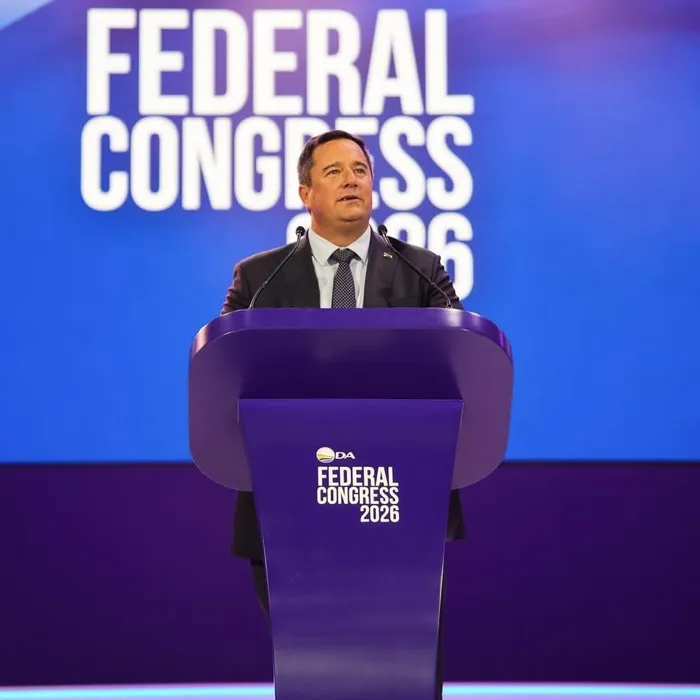
Outgoing DA leader, John Steenhuisen, has declared his mission complete, saying he is leaving the position in a stable manner.
Image: X/DA
In a farewell that doubled as both a victory lap and a warning shot, outgoing Democratic Alliance (DA) leader, John Steenhuisen, declared his mission complete but warned that South Africa is at a crossroads.
Speaking to a packed hall of party delegates, Steenhuisen closed the chapter on nearly five turbulent years, saying the DA had gone from “on its knees” to the heart of national power.
But as he stepped aside, he warned that the country’s fragile progress could yet be undone by a rising tide of populism and division.
The DA is hosting its two-day elective conference at the Gallagher Convention Centre in Midrand.
“It is Mission Accomplished,” he said, his voice steady but charged with urgency. “We are no longer a party of opposition. We are a party in government, shaping the destiny of South Africa.”
The claim is as bold as it is contested.
When Steenhuisen took over in 2019, the DA was reeling, fractured internally, bleeding support, and widely written off.
Polling hovered around 16%, and political obituaries were already being drafted.
His leadership, renewed twice, was defined by a singular gamble: drag the party from decline into relevance through coalition politics.
That gamble, branded the “Moonshot Mission”, has now culminated in the DA entering national government for the first time in its history, as part of the Government of National Unity (GNU).
For Steenhuisen, that moment is nothing short of historic.
“For decades, it was unthinkable that our movement would enter the Union Buildings,” he said. “But we are the generation that changed that history.”
He pointed to tangible wins, blocking a proposed VAT increase, pushing back against the controversial Expropriation Act, and halting the National Health Insurance (NHI) rollout through the courts.
He credited DA influence for early economic signals, improved growth, easing unemployment, and South Africa’s removal from the FATF grey list.
Yet beneath the triumph, the speech sharpened into something more combative.
Steenhuisen repeatedly returned to what he described as an emerging threat, a surge in “illiberalism” marked by ethnic nationalism, anti-foreigner rhetoric, and populist politics.
Without naming parties directly, he warned of a “Doomsday Coalition” already gaining ground in key provinces.“It is an agenda of division and hatred,” he said. “And it must be rejected at all costs.”
Steenhuisen argued that the country now stands as a rare countercurrent in a world drifting toward political extremes.
“While others retreat into division, we must prove that diversity can work,” he said. “Not despite our differences — but because of them.”
The speech balanced legacy-building with political positioning.
Steenhuisen cast the DA as both reformer and firewall, a party that has not only entered government, but prevented what it sees as damaging policy shifts from within.
Still, questions remain about how durable that influence is inside a complex coalition, and whether early gains can translate into long-term electoral dominance.
As he handed over the reins, Steenhuisen struck a final note of confidence, not just in his successor, but in the machine he leaves behind.
“The DA is stronger, larger, and more influential than ever before… The foundations are solid. The mission continues,” he said.
Then, almost as quickly as he had reframed the party’s trajectory, he stepped back into the ranks.
The party is expected to elect its leadership this weekend.
kamogelo.moichela@iol.co.za
IOL Politics