
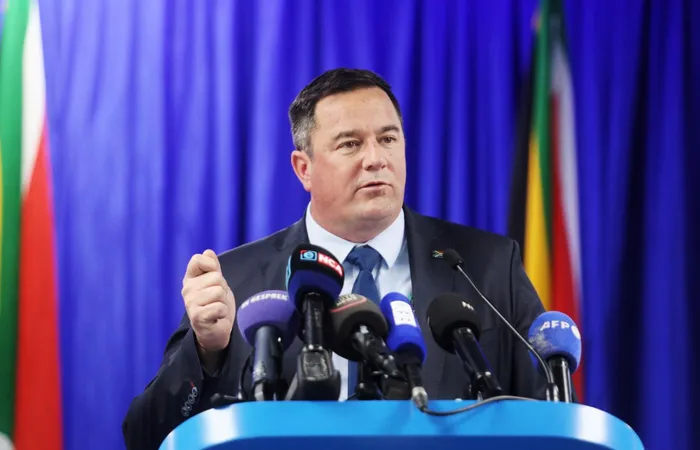
Outgoing DA leader John Steenhuisen said the party will not back down on scrapping BEE.
Image: Timothy Bernard / Independent Newspapers
Outgoing DA leader John Steenhuisen said the party will not back down on scrapping Broad-Based Black Economic Empowerment (B-BBEE) after President Cyril Ramaphosa brushed off the call, saying the policy must be strengthened, not abandoned.
“We reject the protection of BEE, which has benefited only politically connected elites at the expense of the poor, who remain trapped in poverty, locked out of employment, and with little hope of climbing the opportunity ladder," said Steenhuisen.
His remarks followed two days of heated debate at a joint sitting of the National Assembly and National Council of Provinces, where MPs scrutinised and criticised Ramaphosa’s State of the Nation Address (SONA) delivered last week.
Steenhuisen said the party would continue to fight for an alternative that creates a more inclusive economy for all.
“It is for this reason the DA has tabled the Economic Inclusion for All Bill. We will relentlessly pursue the replacement of BEE with a policy that truly focuses on addressing poverty.”
He said South Africa stands at a critical juncture.
“There are encouraging signs of stabilisation under the Government of National Unity, including improving economic fundamentals and renewed investor confidence.
“Most recently the Quarterly Labour Survey reflected employment gains in certain sectors and provinces, (most notably the Western Cape). This progress reflects the value of cooperation, reform pressure and the injection of competence into government.”
However, he said stability is not the same as prosperity.
“The gains are slow and are not felt evenly. South Africans are still living with severe unemployment, crime, failing municipalities and economic growth that is far below what is required to create jobs at scale.
“The DA remains committed to the Government of National Unity because it is helping to stabilise South Africa after years of governance failure, and because it serves as a bulwark against instability and extremist policy alternatives.
“But participation in the GNU does not mean passive support. It means driving reform from within, fighting corruption and holding the executive accountable where urgency is lacking.”
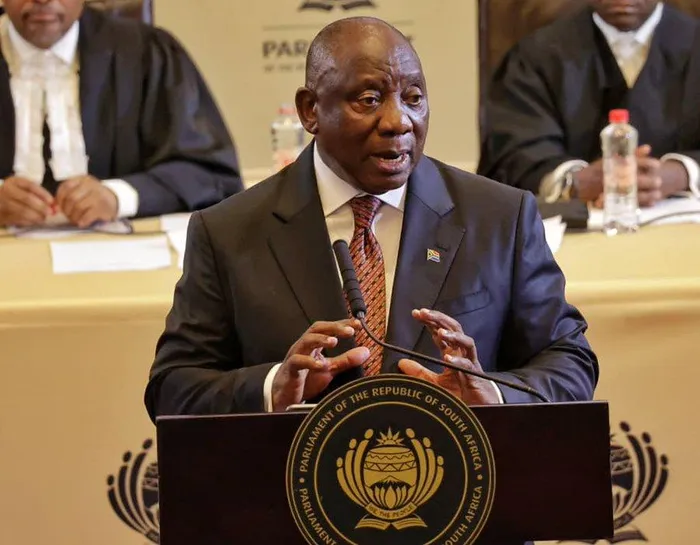
President Cyril Ramaphosa has defended broad-based black economic empowerment, arguing it remains essential to closing income gaps and redressing the injustices of the past..
Image: GCIS
He said while Ramaphosa’s reply reaffirmed reform - which the DA welcomed - it fell short of decisive action, and the party would continue to push for faster implementation.
“The key test following the SONA and the president’s reply is whether the government will accelerate structural reforms that unlock growth and jobs.”
In his reply on Thursday, Ramaphosa said the Constitution calls for redressing the injustices of the past and building a society that is equal and just.
“We cannot do that without transforming our economy. It cannot be acceptable to anyone in this House for African people, coloured people and Indian people to be poorer and have fewer opportunities than white people,” he said.
“It cannot be acceptable to anyone in this House for women to earn less than men, to own less than men and to run fewer businesses than men.”
He criticised those who have called for the scrapping of BEE, saying such claims were based on falsehoods that it benefits only a few, inhibits economic growth and enables corruption.
He said progress since the introduction of these laws was “undeniable”, pointing to changes in ownership patterns, management control, enterprise development and skills development.
“It is no accident that between 2006 and 2023, black African households experienced real income growth of 46%, coloured households 29% and Indian households 19%,” he said.
“It is no accident that the level of poverty in the black African population fell from 67% in 2006 to 44% in 2023.
“Nor is it any accident that the level of poverty in the coloured population fell from 43% to 25% in the same period.”
Despite this progress, he said, the average income of white households remains nearly five times higher than that of black African households.
“This is the gulf we must close through deliberate and sustained efforts to expand opportunity. Now is not the time to abandon BEE. Now is the time to make it more effective.”
He announced a review of the BEE framework to ensure it supports greater transformation and inclusive growth.
During Tuesday’s debate, DA MP Baxolile Nodada said the party would continue challenging the BEE, describing it as a “cadre enrichment scheme dressed up as redress”.
He said it should be replaced with the DA’s empowerment model, focused on poverty as a measure of disadvantage rather than benefiting “the corrupt and criminal”, such as Edwin Sodi and controversial murder-accused businessman Vusimuzi “CAT” Matlala.
The DA has previously introduced the Economic Inclusion for All Bill, which seeks to amend the Public Procurement Amendment Act of 2024 by repealing race-based preferential procurement provisions and replacing them with a poverty-based system of empowerment.
The ANC has repeatedly rejected the proposal and reaffirmed its commitment to BEE.
Meanwhile, Steenhuisen said the DA has consistently called for urgent reforms including improving ports and rail through accelerated private concessions, ending cadre deployment and enforcing merit-based appointments, accelerating energy market reform and the unbundling of Eskom, and ensuring pro-investment policy certainty.
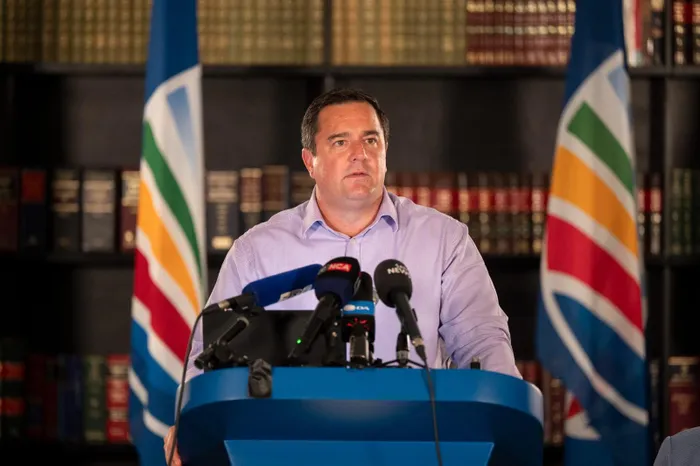
Outgoing DA leader John Steenhuisen says the party will continue pushing to replace broad-based black economic empowerment with a poverty-based alternative.
Image: Armand Hough / Independent Newspapers
“For example BEE must be replaced by an alternative that addresses poverty, not race, such as the DA's Economic Inclusion for All Bill, to attract capital and create jobs.”
According to him, these are practical economic reforms, not ideological positions, and they are essential to achieving sustained growth.
“We have begun to turn a corner, but turning the corner is not the destination. South Africans need faster growth, safer communities, functional municipalities and a government that delivers tangible improvements in their daily lives.
“The DA will continue to use its position in the GNU and in Parliament to push for faster, bolder reform so that South Africa moves beyond stabilisation and onto a path of sustained growth, job creation and opportunity for all,” he added.
simon.majadibodu@iol.co.za
IOL Politics