

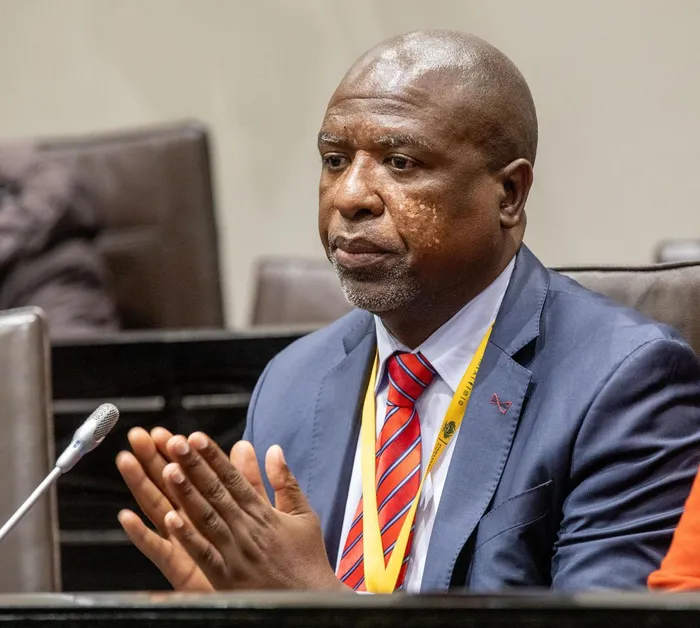
Parliament’s ad hoc committee has considered a packed programme of witness appearances while weighing legal advice from the Speaker’s Office cautioning against premature subpoenas without fully engaging witnesses’ stated reasons.
Image: Parliament of SA
Parliament’s ad hoc committee was briefed on its tight timeline to conclude public participation, hear remaining witnesses and finalise its report, as well as on legal advice warning against rushing the use of subpoenas without fully engaging the reasons advanced by key witnesses.
Presenting the draft programme, committee secretary Vhonani Ramaano told the committee that three key matters remained outstanding: the conclusion of the public participation process, final engagements with witnesses, and the committee’s deliberation and adoption of its report.
He said the committee was expected to finalise and adopt its report on or before February 21 2026.
Ramaano said that four witnesses were scheduled to appear on Tuesday, noting that two of them had formally requested anonymity.
“Members would remember that the Chairperson indicated that there is a member of the public who requested that their name should not be mentioned,” he said, explaining why the programme reflected “Anonymous 1” and “Anonymous 2”.
He added that the second anonymous witness had submitted written material and asked that her identity not be disclosed.
He said that on Wednesday, the committee was due to hear evidence from a police officer, Mr Samuel Ramalepe, who would appear alongside two colleagues from the South African Police Service as well as former acting SAPS national commissioner, Khomotso Phahlane .
The secretariat proposed that the SAPS witnesses be heard in the morning session, with Phahlane scheduled for the afternoon to conclude his testimony and respond to members’ questions on Thursday.
Ramaano said that two Members of Parliament, DA's Dianne Kohler Barnard and Fadiel Adams were proposed to appear on February 11 .
He said three further witnesses remained outstanding, Paul O'Sullivan, Brown Mogotsi and Lt- General Nhlanhla Mkhwanazi, with the committee having already resolved that Mkhwanazi should be the final witness.
No dates had been fixed, he said, because they would depend on the availability of O'Sullivan, Mogotsi and Mkhwanazi.
Legal adviser Andile Tetyana also briefed the committee on responses received from the Office of the Speaker regarding the committee’s request for subpoenas.
He reminded members that the committee had approached the Speaker’s office to issue subpoenas in respect of O'Sullivan and Mogotsi, and that the Speaker had responded with letters dated January 30.
Summarising the Speaker’s position on O'Sullivan, Tetyana said the Speaker noted that the witness had already informed the committee, in correspondence dated 27 November, that he was overseas and intended returning only at the end of February 2026.
He added that O'Sullivan had also cited personal security concerns, including the relocation of seven of his children outside the country.
Tetyana recalled that the committee had taken issue with what it regarded as the “insolent tone” of O'Sullivan correspondence and had declined his request to appear virtually on that basis, without engaging with the substantive merits of his reasons.
He said the Speaker had cautioned that this posed a legal risk.
“The Speaker is merely saying that the committee will have to show that they have engaged with the reasons of Mr O’Sullivan,” Tetyana told members, warning that a failure to do so could render any subpoena vulnerable to being set aside by a court.
He stressed that, under the Powers and Privileges Act, the Chairperson could not authorise a summons on their own and that the Speaker’s concurrence was required, which in turn depended on a rational and lawful exercise of public power.
“The Speaker feels a bit incapacitated in terms of the law to make that determination,” Tetyana said.
He said the Speaker emphasised principles contained in the committee’s own terms of reference, including legality, rationality and procedural fairness, and warned that the exercise of subpoena powers had to be rationally connected to the purpose for which they were used.
Turning to Mogosti , Tetyana said the Speaker had raised serious concerns about the witness’s safety, pointing to a reported attempt on his life in November and disclosures he had made at the Madlanga Commission of Inquiry about his role as an intelligence agent.
He said the Speaker believed these security concerns “should not be taken lightly” and that the committee needed to engage with Mogotsi on the nature, scope and cost of any proposed security arrangements.
Tetyana also addressed the committee’s earlier discussion about appointing an external forensic resource, saying the Speaker’s view was that the necessary skills already existed within Parliament’s legal team and could be utilised if required.
In offering broader legal guidance, Tetyana said Parliamentary Legal Services supported the institution of Parliament rather than any individual committee, and cautioned members about the use of subpoena powers.
He referred to a Supreme Court of Appeal judgment involving the Government Employees Medical Scheme and former Public Protector Advocate Busisiwe Mkhwebane, which highlighted that subpoenas were “extraordinary coercive powers” that courts interpreted restrictively.
“Subpoenas should accordingly only be used where there is an appreciable risk, to be charged objectively, that the evidence cannot be obtained by following a less invasive route,” he said,
He urged members to consider whether alternatives existed before compelling witnesses to appear.
Ad hoc chairperson Soviet Lekganyane said the correspondence from the Speaker’s Office made it clear that the committee needed to carefully consider the reasons advanced by the two witnesses before enforcing subpoenas.
“Especially since the Speaker’s Office is the one that must guide us on how to deal with these matters in accordance with the advice provided to the committee,” he told members.
hope.ntanzi@iol.co.za
IOL Politics