

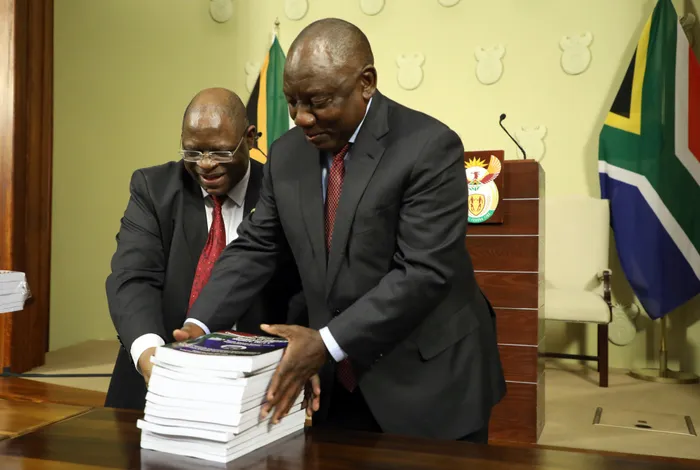
Chief Justice and Commission Chairperson, Judge Raymond Zondo, presents President Cyril Ramaphosa with the report on the Judicial Commission of Inquiry into Allegations of State Capture, Corruption and Fraud in the Public Sector, including Organs of State in 2022. According to the writer, South Africa treated the Zondo inquiry as closure rather than a catalyst.
Image: Supplied
There is currently a stark discrepancy in accountability in South Africa: the Zondo Commission's recommendations regarding the prosecution of prominent politicians have largely stagnated, while the Madlanga Commission's investigation into police corruption has resulted in prompt, high-level arrests.
This is as concerns grow that the Madlanga Commission had triggered rapid criminal law enforcement action, while high-profile politicians implicated in the Zondo Commission are yet to face the music.
The Madlanga Commission, established in July 2025, has so far led to the suspension and ongoing criminal prosecution of 18 top police officials within the SAPS, including National Police Commissioner General Fannie Masemola and Deputy National Commissioner Lt-Gen Shadrack Sibiya.
Masemola, Sibiya, KwaZulu-Natal Hawks head, Major-General Lesetja Senona, and SAPS Employee Health and Wellness Head, Major-General Busisiwe Temba, are facing criminal charges related to a R360 million SAPS health tender awarded to Medicare24 Tshwane District, owned by businessman Vusimuzi “Cat” Matlala.
Other officers suspended and being investigated in connection to the Medicare 24 contract are Captain Brian Neville, Brigadier Rachel Matjeng, Brigadier Alpheus Thembinkosi Ngema, Brigadier Patrick Nethengwe, Brigadier Kirsty Jonker, Brigadier Petunia Reabetsoe Lenono, Brigadier Onica Ofentse Tlhoale, Colonel Nonjabulo Nomfundo Mngadi, Colonel Anton Paulsen, and Colonel Natsenge Johannes Monyai.
Head of Counter and Security Intelligence, Major-General Feroz Khan, and Gauteng provincial head of the Hawks, Major-General Ebrahim Kadwa, were arrested for their involvement in an illicit precious metals syndicate and obstructing justice.
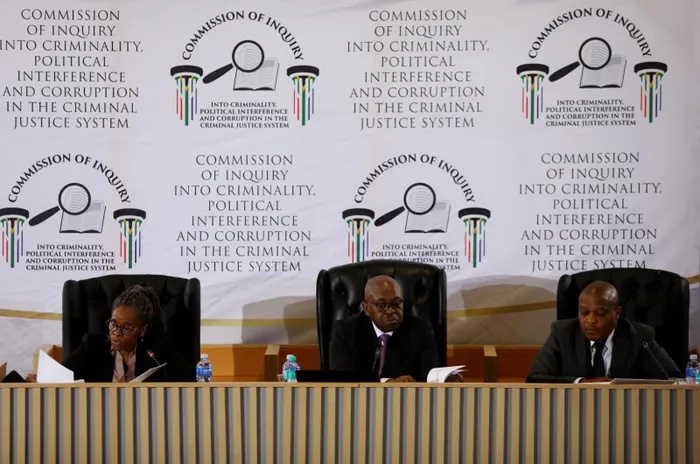
While the Madlanga Commission has yielded immediate results and saw 18 senior police officials suspended and charged, progress on the Zondo Commission remains stagnant.
Image: Oupa Mokoena / Independent Newspapers
On the other hand, while the Zondo Commission recommended the prosecution of over 200 individuals and entities, only former PRASA head of engineering, Daniel Mtimkulu, former Bosasa COO, Angelo Agrizzi, and the late SAA board chairperson Dudu Myeni were convicted and sentenced.
Despite many officials being processed through the courts, progress remains frustratingly slow, with few high-profile convictions.
Asked why the National Prosecuting Authority (NPA) was able to act so quickly on senior cops implicated at the Madlanga Commission, while no progress has been made on the prosecution of politicians implicated at the Zondo Commission and other politicians implicated in alleged corruption, spokesperson Kaizer Kganyago did not respond.
Department of Justice and Constitutional Development spokesperson, Palesa Rammitlwa, also did not respond, saying questions must be sent to the NPA.
Following his appointment in February, National Director of Public Prosecutions Andy Mothibi assured the public that the NPA remains deeply committed to prioritising and fast-tracking State Capture prosecutions.
Mothibi acknowledged a prevalent public perception that the NPA protects high-profile individuals while primarily convicting ordinary citizens. He disputed that the authority is not working hard enough, stating that changing this narrative through “significant execution”, is a core focus.
He vowed to restore the NPA's institutional credibility by pursuing impactful, high-profile matters to the full extent of the law.
However, political analyst Zakhele Ndlovu said the disparity between the two commissions sends a message of institutional bias, selective justice, and a case of “some animals being more equal than others”.
Ndlovu added that this will leave many questioning the fairness of the criminal justice system.
“One gets the sense that some politicians are being protected,” he said.
Ndlovu stated that former President Jacob Zuma was made a scapegoat and a poster boy for corruption in the arms deal, even though many other politicians were equally guilty.
“This sends a very bad message. It suggests that some people are above the law,” said Ndlovu, adding that ANC factional battles also play a role in this.
“Ramaphosa is protecting those in his faction. Mchunu is a case in point. Remember how Mbeki protected Jackie Selebi? So this is not new,” he said.
Another political analyst, Professor Ntsikelelo Breakfast, said there have always been political elements in how state capture cases are handled by the NPA.
He said there was always a concern that there seems to be politicisation of these cases, adding that this has compromised the integrity of the NPA.
“This also shows the nexus between politics and law. Who knows if Ramaphosa will not be prosecuted when his term is over, like they instituted charges against the former speaker of Parliament (Nosiviwe Mapisa- Nqakula) and Zizi Kodwa,” he said.
Mapisa-Nqakula faces 12 counts of corruption and one of money laundering related to allegations that she accepted R4.5 million in kickbacks from a defence contractor between 2016 and 2019.
She denies all charges, saying she has no propensity to commit crimes.
Kodwa, the former ANC spokesperson, faces charges of fraud and corruption for allegedly receiving payments from Jehan Mackay, a former executive at the technology outsourcing firm Enterprise Outsourcing Holdings (EOH), to influence the irregular awarding of government IT software contracts.
He denied the charges, stating that the funds he received were non-transactional loans from a close friend rather than bribes.
manyane.manyane@inl.co.za