

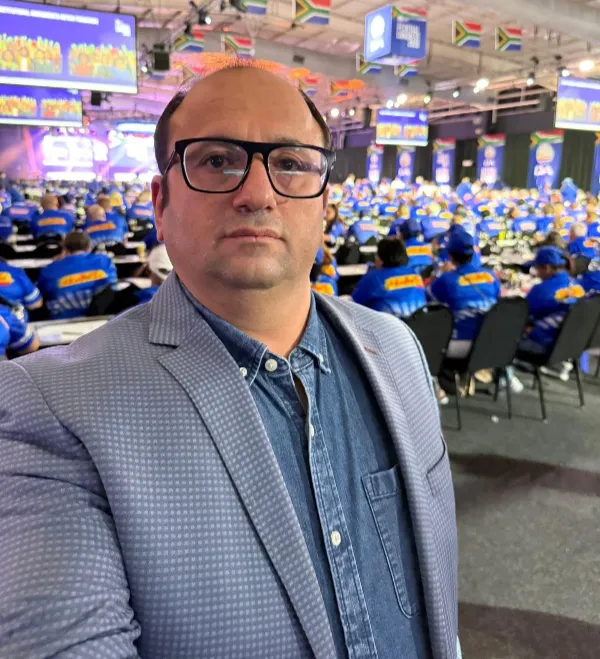
Turkmen Terzi. Turkish journalist living in South Africa.
Image: Journalist
By Turkmen Terzi
As a foreign journalist who has lived abroad since 2003, I have personally witnessed how a nation’s global image can slowly be damaged by unresolved historical disputes, political polarization, and defensive communication. As a Turkish journalist who made South Africa my home, it is natural for me to compare South Africa’s current struggles with Turkey’s experience. I was already living in South Africa when President Recep Tayyip Erdoğan’s government began aggressively targeting independent media and journalists after 2013. Over time, returning became impossible for many journalists and critics of the government. I have lived in South Africa since 2009. My children were born here. This country is not simply a place where I reside — it is home. And because I now consider myself part of South African society, I believe it is my duty to write honestly and constructively about the dangers the country faces.
South Africa stands at a dangerous crossroads. The country does not need louder slogans, more political theatre, or defensive nationalism. It needs honest communication. If South Africans fail to confront difficult realities openly and responsibly, future generations may pay the price — not only economically and socially, but also in how the world comes to understand and judge the country.
History shows how quickly international narratives can harden into permanent global perceptions.
Turkish people are widely known across many regions for generosity, hospitality, and helping the weak and poor. One story often remembered is how the Ottoman Empire sent aid ships to Ireland during the Great Famine. Yet despite this humanitarian legacy, modern global discourse around Turkey has increasingly become dominated by disputes over the Armenian tragedy, the Cyprus issue, Kurdish conflicts, and accusations surrounding state violence. Whether one agrees with every claim or not, the result has been decades of international campaigns that shaped a deeply negative perception of Turks in many parts of the world.
The lesson is not about denying history. The lesson is that when nations respond to criticism only with defensiveness, silence, or propaganda, they lose control of their own story.
South Africa risks walking into the same trap.
This country achieved something extraordinary after apartheid. Instead of descending into large scale racial revenge, South Africans chose reconciliation. Nelson Mandela and many others helped build a democratic state where black and white citizens could coexist under one constitution. The ANC did not pursue mass retaliation against white South Africans after liberation. That remains one of the most remarkable political transitions in modern history.
At the same time, South Africa has hosted millions of African migrants and refugees over decades. People from Zimbabwe, Mozambique, Somalia, Ethiopia, Nigeria, the Democratic Republic of Congo, and many other countries came seeking safety, opportunity, and dignity. This alone should be recognized globally as evidence of South Africa’s openness and continental responsibility.
Yet today, international narratives are shifting.
US President Donald Trump and some foreign commentators accuse South Africa of targeting white farmers and even promote claims of “white genocide.” Meanwhile, countries such as Nigeria, Kenya, and Ghana increasingly criticize South Africa over xenophobic violence against African migrants. On social media, isolated incidents become global headlines within hours. Perception spreads faster than truth.
This is precisely why South African leaders must resist the temptation of populism and denial.
Denying xenophobia entirely does not solve xenophobia. Dismissing farm attacks as “just crime” without acknowledging the fears surrounding them does not build trust either. A mature society does not weaken itself by admitting problems, it strengthens itself. Countries earn global respect when they confront difficult issues honestly and transparently.
South Africa should say clearly: Yes, xenophobic violence exists and must be confronted. Yes, violent crime affects farmers and township residents alike.
Yes, poverty, unemployment, corruption, and inequality fuel anger and social instability. But South Africa must also say something equally important.
These problems do not define the soul of the nation. The real spirit of South Africa is still Ubuntu, the belief that a person becomes human through other people. It is seen every day in ordinary life: 65 million people greeting one another warmly, smiling in the streets, helping neighbors, mixing languages and cultures naturally, and continuing to live together despite enormous pressures.
That human spirit is South Africa’s greatest national asset. But Ubuntu alone cannot protect the country’s future if leaders refuse honest communication. The world is changing rapidly. Narratives are becoming weapons. Countries that fail to explain themselves truthfully will have their stories written by outsiders, activists, political opportunists, and internet outrage.
South Africa must therefore choose wisdom over defensiveness. Address the violence honestly. Address xenophobia honestly. Address racial fears honestly. Protect both citizens and migrants. Reject extremism from every side.
As ordinary Anatolian Turks only found the opportunity to move abroad, expand businesses, and become globally active after Prime Minister Turgut Özal’s liberal economic reforms following the 1980 military coup period, they only began facing organized anti Turkish propaganda once they became internationally visible. For decades, Turkey’s rigid secular establishment kept ordinary conservative Turks away from major economic influence and global participation. In a similar way, apartheid excluded the black majority in South Africa from full participation in the economy until 1994.
Today, a new generation of educated, free born black South Africans is entering global business, diplomacy, academia, and international networks. They sit in restaurants in New York, London, Dubai, Casablanca, Nairobi, Lagos, and other global capitals discussing investments, partnerships, and opportunities. But increasingly, they may hear stories about “white genocide,” xenophobic violence, racial instability, and social collapse from potential business partners and foreign media narratives, just as many Turks abroad increasingly encountered anti Turkish political narratives once Turkey became more globally connected.
Because if South Africa fails to communicate truthfully and responsibly now, future generations may inherit not only unresolved problems, but also a distorted global image that becomes almost impossible to reverse.
South Africa’s miracle was never perfection. Its miracle was the willingness to face pain without losing humanity. That is the spirit the country must protect.
*Turkmen Terzi is a foreign journalist based in South Africa.