

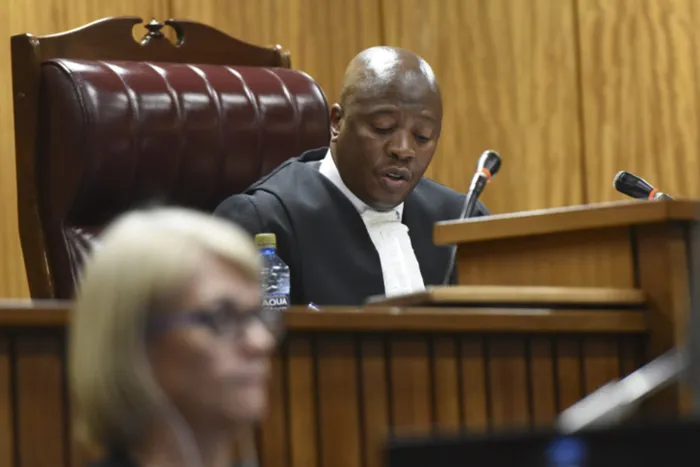
Gauteng Deputy Judge President Aubrey Ledwaba's path to becoming the next Judge President is complicated by his recent implication at the Madlanga Commission.
Image: Photo: HERMAN VERWEY/EPA
Gauteng Deputy Judge President Aubrey Ledwaba has been recommended for the role of Judge President of Gauteng. The Judicial Service Commission (JSC), the body responsible for overseeing the appointment of judges,will forward Ledwaba's name to the president for consideration.
Grilled on Tuesday during his interview, Judge Ledwaba denied that he took a bribe in the KT Molefe bail appeal and said the fact that his name came up at the Commission is still a surprise to him.
He was grilled by a panel during his interview, for which he was the only candidate shortlisted for the position. Chief Justice Mandisa Maya warned him that the allegations before the Madlanga Commission would be a “big issue” during the panel’s deliberations regarding voting for or against his appointment.
She said the question will arise as to why they should not wait for the final word of the Madlanga Commission on the bribery claims before considering his appointment. She referred to objections which the JSC received against his appointment, especially from the Helen Suzmann Foundation, given the allegations against him. “The elephant in the room is that your candidature is shrouded in this dark cloud,” Justice Maya said.
Judge Ledwaba responded that the allegations against him held no substance and that it would not be in the interest of justice to wait for the Madlanga Commission to eventually pronounce on the allegations, as the Gauteng Division needed a leader. His recommendation as next Judge President came as public scrutiny continues following testimony heard at the Madlanga Commission, which among others included allegations of impropriety surrounding the granting of bail to underworld figure Katiso “KT” Molefe.
Last year, Witness A told the Madlanga Commission that he had received information from an informant that R2.5 million was set aside to cover Molefe's bail. The witness said the money was allegedly intended to influence the bail outcome but conceded that he could not confirm whether the funds were meant for Judge Ledwaba or the public prosecutor involved in the matter.
Judge Ledwaba told the JSC that he came to hear of the allegations for the first time in the media. Through his attorney, he questioned the Commission as to why it did not beforehand warn him about the allegations. According to him, the Commission responded that it would issue a report dealing with the matter, which has not yet been done, nor was he called to testify before it.
He explained that he does not know Molefe and has never dealt with him, other than to hear his bail appeal after a magistrate had refused bail. He granted the bail as he found the magistrate had erred in his reasons for refusing it. What is most interesting, he said, is that shortly after this, when Molefe was again arrested on murder charges, a magistrate also granted him bail on that matter and nothing was said about this.
“When I dealt with his bail appeal, it was in the normal course of my work,” he said. He explained it was during recess and there were no other judges available. While there were suggestions that he should take special leave amid the allegations, Judge Ledwaba said he decided against it after speaking to some retired judges, who pointed out that the allegations were unsubstantiated.
Another subject under scrutiny was the fact that he allowed controversial Judge Portia Phahlane to preside over the International Pentecost Holiness Church case. Judge Ledwaba explained that he allocated the case to her for management. The usual practice is that another judge would be allocated to hear the actual trial. But in this case, both parties agreed she should continue with the trial.
She complained at a stage that she was threatened during the trial and she appointed her own security after the court did not afford her protection. Judge Ledwaba said it was disturbing that private armed security was in the building, but as she was under threat, he was concerned about her safety. He never suspected anything untoward.
zelda.venter@inl.co.za