

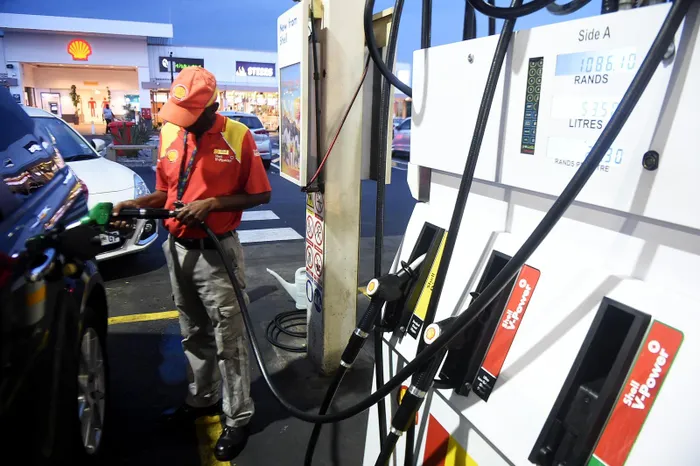
Motorists rush to fill tanks at a petrol station yesterday along the M2 before a fuel price increase.
Image: Itumeleng English/ Independent Newspapers
South Africans are facing a significant increase in the cost of living as the country prepares for the largest recorded fuel hike, particularly for diesel.
While the government has introduced temporary relief measures, the fuel crisis remains a serious concern, said Abigail Moyo, spokesperson for the trade union UASA.
Effective tomorrow, petrol prices will rise by R3.06/L and diesel by up to R7.51/L. LPGas will also increase by R1.08/kg.
These hikes coincide with the NERSA-approved 8.76% electricity tariff increase for Eskom direct customers, further straining households already under financial pressure.
Despite Minister of Finance Enoch Godongwana’s announcement of a R3/L relief on the general fuel levy—bringing the petrol levy to R1.10/L and the diesel levy to R0.93/L—the Road Accident Fund and Carbon Fuel levies remain unchanged.
Moyo said they welcomed the temporary relief but expressed concern for low-income households that rely on paraffin.
''UASA reminds the government that many households, particularly those with low incomes, depend on paraffin for cooking, heating, and other needs. These households also require relief measures to address the rising cost of living.''
The National Treasury and the Department of Mineral and Petroleum Resources (DMPR) have jointly announced a short-term relief measure in the form of a R3 tax reprieve for petrol and diesel for the month of April. This will temporarily reduce the general fuel levy from R4.10 per litre to R1.10 per litre on petrol and from R3.93 to 93 cents in the case of diesel.
The DMPR announced on Tuesday that both grades of petrol will see a price increase of R3.06 per litre, while diesel will increase by between R7.37 (500ppm) and R7.51 (50ppm). Illuminating paraffin will see a price hike of R11.67 per litre.
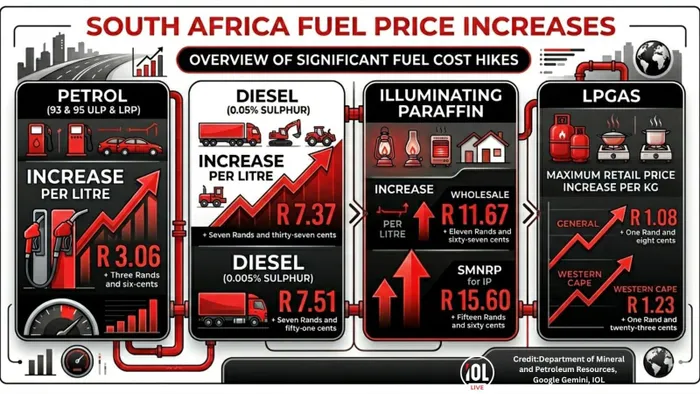
South Africa's official fuel price increases.
Image: IOL
After the price adjustments take effect on Wednesday, April 1, a litre of 95 Unleaded petrol will cost R22.53 at the coast and R23.36 in the inland regions, where 93 Unleaded will cost R23.25. The wholesale price of 50ppm diesel will rise to R25.35 at the coast and R26.11 in Gauteng.
Treasury said the relief measure, which will cost the government around R6 billion per month, will be re-evaluated on a monthly basis for the following two months. The relief measure is designed to be fiscally neutral, it said, and the government will implement mechanisms to recoup the foregone revenue within the fiscal framework approved during the 2026 Budget.
Government further reiterated that there is sufficient fuel supply in the country to meet current and projected demand. It said the shortages reported in certain areas were largely due to localised distribution and logistical challenges driven by panic buying rather than a lack of national fuel stocks. These should self-correct in the coming days, it added.
The government is also exploring a broader package of measures to support households and key sectors of the economy, of which further details will be announced at a later stage.
Rising fuel prices in April are expected to feed through the economy, with the transport and logistics sectors likely to bear the brunt. Higher diesel costs, in particular, tend to push up operating expenses across supply chains, placing further strain on businesses already grappling with weak demand.
For consumers, the impact is usually felt in the form of higher prices for essentials such as food and household goods, as distribution costs increase. This fuel-driven pressure is also likely to complicate South Africa’s inflation outlook, potentially reducing the scope for interest rate cuts.
The South African National Taxi Council (SANTACO) has warned that taxi fare increases may be imminent as operators grapple with fuel shortages, rising diesel costs, and supply constraints across the country.
In a statement, the council said growing uncertainty around projected fuel price increases has already begun to affect daily operations.
IOL Motoring
Additional Reporting: The Star Reporter