

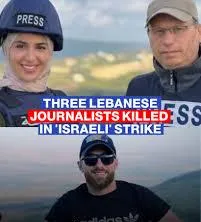
Three reporters killed on Saturday when an Israeli airstrike hit their media vehicle near Jezzine, southern Lebanon.
Image: Facebook
Three journalists were killed after an Israeli airstrike struck a media vehicle in southern Lebanon on Saturday near Jezzine.
Those killed were identified as Ali Shoaib, a correspondent for Al-Manar TV, and Fatima Ftouni and her brother Mohamad Ftouni, both affiliated with Al-Mayadeen TV.
According to reports, the journalists were covering events near Jezzine at the time of the attack. The strike has drawn condemnation from press freedom groups, who said targeting journalists violates international law.
Al-Mayadeen TV reported that the journalists were en route to an assignment when their vehicle was hit.
The Committee to Protect Journalists (CPJ) reported that the Israel Defence Forces (IDF) confirmed carrying out the strike, identifying Shoaib, referred to as Ali Hassan Shaib, as a member of Hezbollah’s Radwan Force.
The IDF also alleged that Shoaib used journalism as a cover for intelligence-gathering and maintaining contact with Hezbollah fighters, though no evidence was provided to support these claims.
Israeli military spokesperson Avichay Adraee posted on X that Shoaib was a Hezbollah intelligence-gatherer. CPJ said it had requested further information from the IDF regarding the strike on all three journalists and was told the matter is still under investigation.
“CPJ is investigating this latest attack on journalists in Lebanon which has been an increasingly deadly zone for journalists, despite their status as civilians who must not be targeted. We have seen a disturbing pattern in this war and in the decades prior of Israel accusing journalists of being active combatants and terrorists without providing credible evidence. Journalists are not legitimate targets, regardless of the outlet they work for,” said CPJ Regional Director Sara Qudah.
Lebanese President Joseph Aoun and Minister of Information Paul Morcos condemned the strike, with Aoun describing the killings as “a blatant crime that violates all the norms and treaties under which journalists enjoy international protection in wars.”
The strike near Jezzine comes amid a deadly pattern for journalists in the region. At least four other journalists have been killed in the Middle East since the Iran conflict escalated in late February, including photojournalist Hussain Hamood, who died two days earlier, and Mohammed Sherri of Al-Manar TV, killed nine days prior in Beirut.
These deaths bring the number of journalists and media workers killed in Lebanon since the start of the Israel-Gaza war to at least 11. CPJ, which monitors attacks on media globally, has also recorded at least 11 journalists and media workers killed so far in 2026, using a data management system launched in 2025 with support from the Leon Levy Foundation to track journalists who are killed, missing, or imprisoned in conflict zones.
South African media bodies and government have previously condemned the killing of journalists in conflict zones. The South African National Editors' Forum (SANEF) called such attacks “a deplorable” assault on press freedom and human rights and expressed concern over instances where journalists are labelled combatants without evidence. South Africa’s Department of International Relations and Cooperation (DIRCO) has repeatedly called for the protection of civilians, including journalists, and for adherence to international humanitarian law in conflict areas.
The Star
masabata.mkwananzi@inl.co.za