
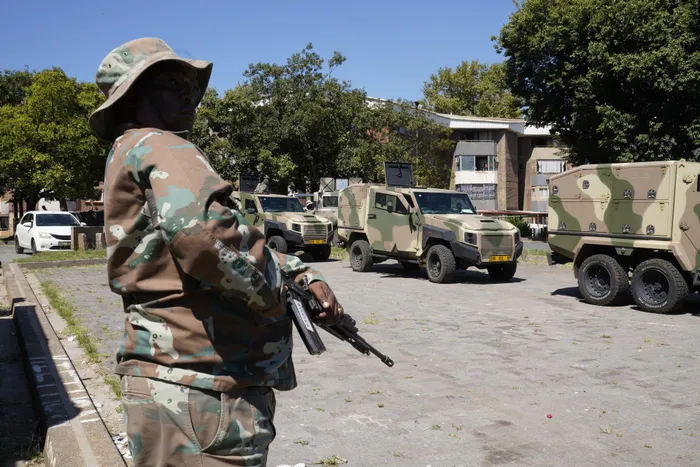
SANDF chief General Maphwanya reassured communities that the soldiers are there to protect them, not to cause harm.
Image: Timothy Bernard / Independent Newspapers
The South African National Defence Force (SANDF) in conjunction with the SAPS, is deploying forces not to “skop, skit en donder” approach but to defend citizens and combat crime.
SANDF chief General Rudzani Maphwanya allayed fears among some communities that they are likely to face violence meted out against them by the soldiers.
He was addressing a joint media briefing at the Natjoint Operation Centre in Pretoria on Sunday with SAPS Commissioner General Fannie Masemola.
This follows President Cyril Ramaphosa’s authorisation of the deployment of 2,200 SANDF members to support the SAPS in five provinces until March 2027 under Operation Prosper to tackle illegal mining and gang-related violence. The operation is expected to cost over R823 million, targeting the Free State, North West, Gauteng, Western Cape, and Eastern Cape.
Addressing the ‘skop, kiet and donder’ claims, Maphwanya said: “We are not going there to harass our people. Only criminal elements will feel harassed.”
He also addressed concerns about the alignment between SANDF and SAPS in terms of their mandate to deal with crimes,
He said SANDF training has models that cater for most of the cooperation arrangements that must be conducted when working with the police.
“We also plan during our preliminary arrangements that we will do our own combat readiness training and at a later stage when we prepare for a final mission we do a joint mission readiness training and that is the training that we conduct together and that is the training that harmonise our way of doing things,” he said.
He cited that both the SANDF and SAPS have established rules of engagement and communication protocols among themselves.
Maphwanya highlighted the existing collaboration between the SANDF and SAPS, citing joint efforts in Operation Vala Umgodi targeting illegal mining, as well as operations during taxi violence and gang violence in the Western Cape.
“Operational procedures will ensure that we continue to work together but at the same time, we will continue to allow the police to align with broader crime justice processes,” he said.
For example, he said, the collection of evidence and management of crime scenes will remain the sole responsibility of the police.
“We will allow the police to continue policing. While you threaten the police while they are busy with their work we will ensure that we stabilise that environment and allow the police to do their work,” he said, adding that forces will create conditions that will make it impossible for those criminals to continue to operate with impunity.
Masemola shared the same sentiments, adding that he could not disclose exactly where the police and soldiers will be deployed in those provinces, saying such details will be with the tactical commanders.
Questioned about the claims that some police officers were not cooperating with the soldiers on the ground, Masemola said he was not aware of them.
“The report we are getting from commanders is that they are working seamlessly together, both SAPS and SANDF. If there are those elements that are not cooperating we will deal with them in terms of the disciplinary steps,” he said.
He reiterated that it was not the first time the SANDF and SAPS worked together and that they just needed the refresher training they were being given.
He mentioned that the operation also included other stakeholders such as SARS, the Special Investigating Unit and the Border Management Authority.
Masemola said NATJOINTS will manage operational coordination, overseeing intelligence-led planning and ensuring security agencies and government departments work together.
He added that Joint Operational Centres are also in place to facilitate coordination among SAPS, SANDF, and other law enforcement agencies.
“The objectives of this joint deployment are clear: to stabilise priority crime hotspots, dismantle organised criminal syndicates, restore law and order, and reclaim communities from criminal networks,” he said.
Regarding the Eldorado shooting incident, he said: “Yes, there was a shooting in Eldorado Park. Our deployment will be reinforced and we will continue doing our work.”
Maphwanya stated that the SANDF is currently underway with one operation, and in the second phase of Operation Prosper, they will be adding more troops and increasing working hours.
“We will deal with those criminal elements. If they are effective at night we will also be effective at night," he said.
rapula.moatshe@inl.co.za