

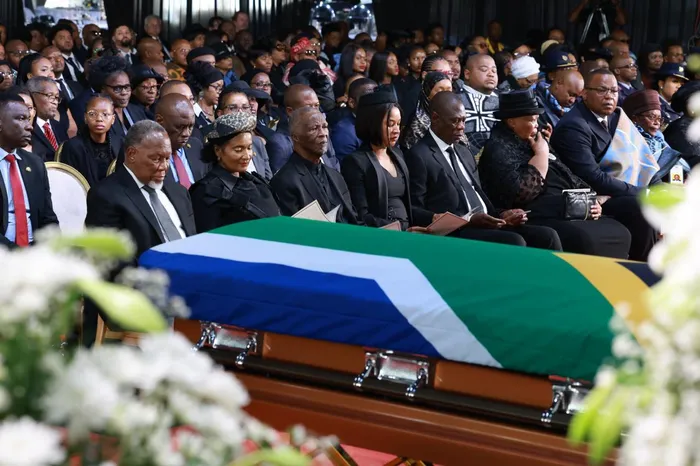
Mosiuoa Lakota was laid to rest on Saturday
Image: GCIS/SUPPLIED
The reign of “Terror” came to an end in Bloemfontein on Saturday, as COPE founder and ex-defence minister Mosiuoa Lekota was laid to rest.
Lekota, who got the nickname “Terror” for his tough style on the soccer field in his younger days, was honoured at Old Grey Sports Club in Willows, where mourners gathered to bid him farewell.
Lekota, of Kroonstad, died on Wednesday last week after a lengthy illness.
He was 77.
Among those who paid tribute was former North West premier Popo Molefe.
“He was like a bulldog,” Molefe said of the hothead politico who finished his secondary education at St Francis College in Mariannhill, a Catholic school whose former pupils included Robert Mugabe and Steve Biko.
“The man was brave and strong like a bull.”
Molefe said Lekota, who enrolled at the University of the North after matriculating in 1969 and joined the SA Students’ Organisation there, never gave up on the goals he believed in.
Lekota’s Black Consciousness activism later led to his expulsion from the university in 1972.
“He was a resilient guy, tenacious, and in Terror’s vocabulary, the word defeat or failure did not exist,” he said.
“He never gave up on the goal he pursued."
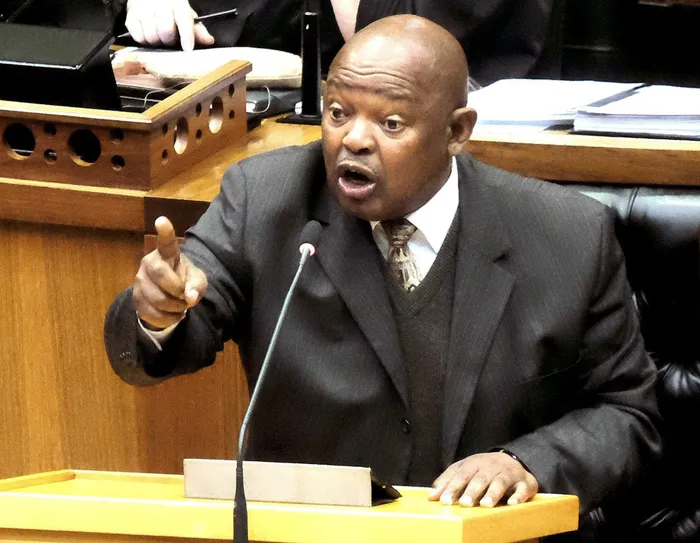
The late Cope leader Mosiuoa Lekota
Image: Ian Landsberg
His involvement with Saso, however, continued off campus.
In 1974, he became a full-time organiser for the student body. It was also in that year that he married Cynthia.
Lekota’s activism soon brought him into the crosshairs of the apartheid state.
He was jailed in 1974 and spent eight years on Robben Island, from 1974 to 1982, alongside other anti-apartheid activists, including Nelson Mandela.
And even after his release, he remained active in the struggle and was detained again in the 1980s.
ANC secretary-general Fikile Mbalula said Lekota’s life was shaped by prison cells and political struggle.
“Through prison cells and relentless political struggle, he was among those who refused to surrender the hope that one day South Africa will belong to all who live in it,” Mbalula said.
“It has taken from us a soldier of our liberation struggle.
“It has silenced the voice that spoke firmly in defense of justice and democratic values.
“But death cannot erase the contribution of a life dedicated to the emancipation of others.
“The legacy of Comrade Terror lives not in this moment of sorrow, but in the history of struggle that he helped to shape.”
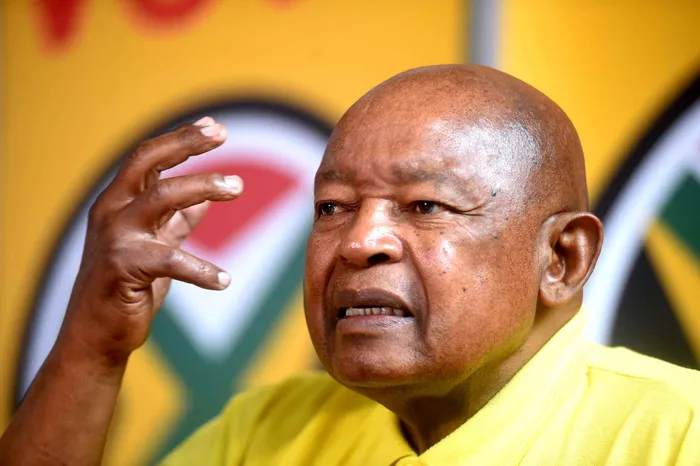
Veteran anti-apartheid activist and former defence minister Mosiuoa Lekota
Image: Itumeleng English
Mbalula said those who knew Lekota would remember his sharp mind and firm views.
“Those who knew him will remember his clarity of thought," he said.
"They will remember the sharpness of his intellect and the firmness of his convictions.
“He was not a man who sought comfort in silence when truth demanded to be spoken.
“He was a man who believed that leadership requires courage, the courage to confront injustice even when doing so invites misunderstanding.”
Former finance minister Trevor Manuel said Lekota was a man whose life reached beyond party politics.
“We gather to take leave of the giant-hearted Lekota,” Manuel said.
“He was giant-hearted in every respect, and when a giant heart leaves, it offers us an opportunity to reflect on their life, but also to peer into our collective hearts as a nation.”
Manuel said one of the striking things about the funeral was how many political formations were represented.
“One of the features of this funeral today is that the colours of so many political organisations are represented here, because in many respects,
"Lekota was bigger than any political organisation,” he said.
In democratic SA, Lekota went on to hold some of the highest offices in government.
He was the first premier of the Free State after the advent of democracy, later became chairperson of the National Council of Provinces, and then served as defence minister from 1999 to 2008.
His relationship with the ANC then broke down after former president Thabo Mbeki was ousted in 2008.
Lekota was among the senior ANC figures who broke away and helped form the Congress of the People, better known as COPE, in one of the biggest political splits of the democratic era.
The party went on to become the third-largest opposition force after the 2009 elections.
Delivering the main eulogy, deputy president Paul Mashatile said Lekota's life was lived in pursuit of a better SA, marked by honesty, integrity, and courage.
"Terror Lekota understood that leaders are transient, but the congress as an ideal of unity and justice is eternal.
"He knew the measure of a leader is not how long he holds office, but how faithfully he serves the covenant of congress."
Mashatile added: "He understood that leadership is not command, but service.
"For him, democracy was never a distant set of rules.
"It was a living instrument to transform the lives of ordinary people.
"He dedicated himself to ensuring that the constitution became a shield for the vulnerable."
IOL