
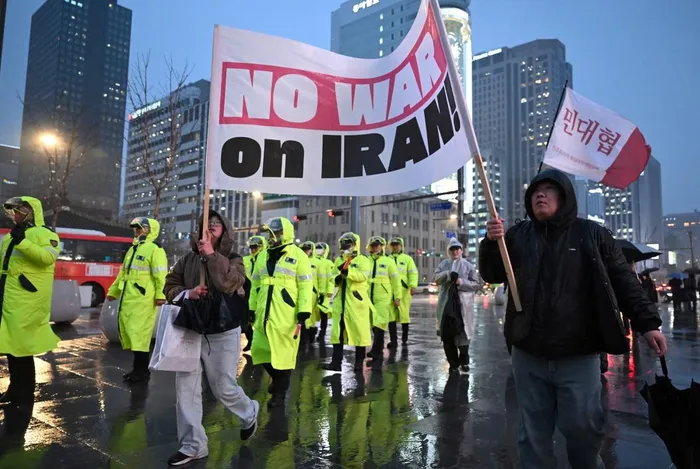
Protesters carry a banner reading "No war on Iran!" as they march toward the US embassy during a rally condemning the US and Israeli attacks on Iran in Seoul on March 5, 2026. US President Donald Trump announced on Sunday that he would decide, in collaboration with Israeli Prime Minister Benjamin Netanyahu, to conclude the ongoing US-Israeli conflict with Iran.
Image: Photo by Jung Yeon-je / AFP
US President Donald Trump announced on Sunday that he would make the decision to conclude the ongoing US-Israeli war on Iran in collaboration with Israeli Prime Minister Benjamin Netanyahu. In a brief phone interview with the Times of Israel, Trump remarked, “I think it’s mutual… a little bit. We’ve been talking. I’ll make a decision at the right time, but everything’s going to be taken into account.”
The backdrop of these remarks comes as the US and Israel have engaged in extensive military operations against Iran since February 28, which have resulted in catastrophic losses, including the deaths of over 1 200 individuals, among them Iran’s Supreme Leader Ayatollah Ali Khamenei, numerous senior military officials, and tragically, over 150 schoolgirls caught in the crossfire.
Despite the heavy toll, the precise duration and potential escalation of military actions remain uncertain.
The White House had previously indicated expectations for the conflict to persist for four to six weeks; however, the shifting dynamics of the situation have left observers questioning the reliability of such timelines. Trump has notably refrained from committing to a specific timeframe for the conflict, stating, “I don’t think it’s going to be necessary,” when asked whether Israel may continue its military actions independently after the US curtails its strikes.
Meanwhile, AFP reports that the Middle East war is shaking markets, oil and the global economy
A delivery staff unloads liquefied petroleum gas (LPG) cylinders from a truck at a distribution point in Mumbai on March 10, 2026. Oil prices tanked and equities rallied on March 10, following a wild day of swings that came after Trump said the US-Israel war on Iran would be ending earlier than thought.
Here are the latest economic events in the Middle East war on Tuesday:
* Asian and European stock markets rallied, and energy prices eased after US President Donald Trump signalled that the US-Israel war on Iran was "going to be ended soon".
* Tokyo's Nikkei 225 index added more than three percent and the Nang Seng was up 1.5 percent in Hong Kong while Seoul's soared more than six percent as Shanghai advanced a more cautious 0.5 percent.
* European equities were also in the green. Frankfurt's DAX index of top German companies jumped 2.2 percent, the Paris CAC 40 rose 1.7 percent and London's FTSE 100 advanced 1.6 percent. Milan added 2.5 percent.
* Energy prices slide back -
* World oil prices dropped by around eight percent and European natural gas prices plunged after Trump's comments.
* Brent crude and US crude oil benchmark West Texas Intermediate were hovering either side of the $90 a barrel mark after Monday soaring to almost $120 on fears of fallout disruption to energy supplies from the Middle East.
* But they remain around 20 percent higher than prior to the start of the conflict.
* European gas prices tumbled around 15 percent with the Dutch TTF natural gas contract, considered the European benchmark, trading at around 48 euros ($56), after rising sharply the day before.
* Iran warns will block Gulf oil - - Iran on Tuesday vowed to block oil exports from the Gulf while its war with the United States and Israel continues, in a stark rebuke to Trump's boast that the conflict was all but over.
* Oil prices spiked after Iranian attacks on shipping closed the strategic Strait of Hormuz in response to the US-Israeli strikes that killed its supreme leader.
* The Islamic republic's Revolutionary Guards Corps (IRGC) mocked Trump's apparent bid to lessen the economic impact of the war, warning: "The Iranian armed forces... will not allow the export of a single litre of oil from the region to the hostile side and its partners until further notice."
* SAS airline hikes prices - - Scandinavian airline SAS said it will introduce a "temporary" price increase due to soaring oil prices triggered by the war in the Middle East.
* "In recent days, jet fuel prices in Europe have risen sharply -- reaching their highest levels since 2022 -- largely driven by disruptions to global supply. This development affects the entire aviation industry and has an immediate impact on airlines' cost base," the company said in a statement to AFP.
* G7 energy ministers G7 energy ministers are to meet Tuesday in Paris to discuss energy policy, French government spokesperson Maud Bregeon told France 2 television.
* "We shall convene the G7 Energy meeting on the sidelines of the international nuclear summit being held in Paris to make progress on this (oil price) issue, with the aim of lowering prices," said Bregeon, who is also minister delegate for energy.
* Egypt hikes fuel prices - - Egypt raised domestic fuel prices by up to 30 percent on Tuesday, blaming "exceptional" global energy pressures caused by the Middle East war, which has disrupted oil supplies and shipping routes.
*The increases, announced by the petroleum ministry, apply to gasoline, diesel and natural gas used in vehicles.
Additional Reporting: AFP