
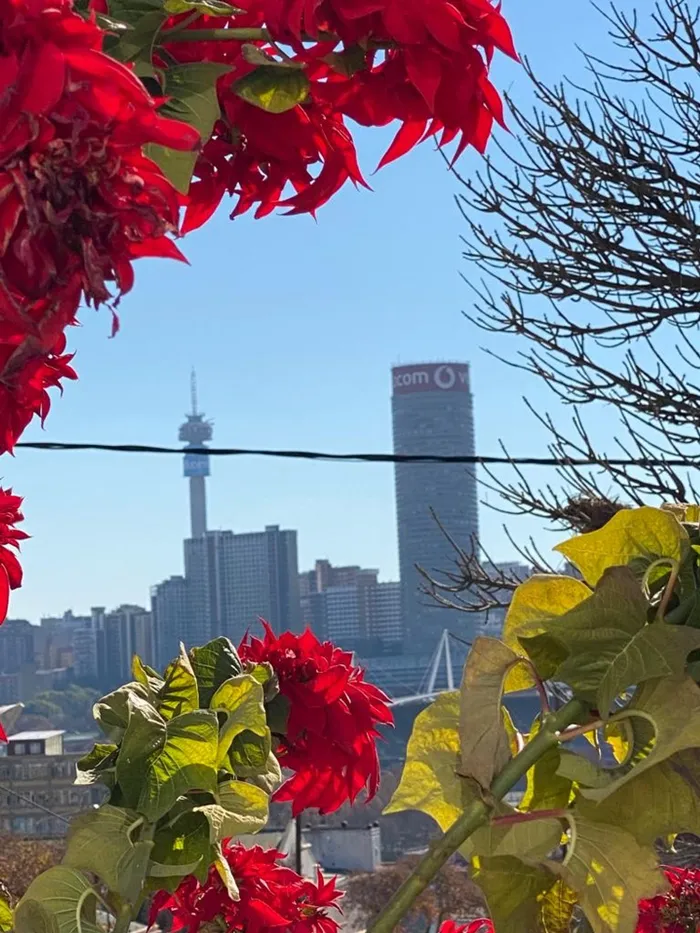
Johannesburg buildings, viewed from the Troyeville House.
Image: Norman Cahi
Non-governmental organisations are set to conduct site visits at several government-leased buildings in Johannesburg on Saturday. This follows media reports on Gauteng’s rental expenditures, which reportedly run into millions of rands. The inspections will be led by Right to Justice and the Integrity Network, who say they aim to verify the occupancy and condition of government-leased properties.
Much of the public focus has been on 55 Fox Street and 56 Eloff Street in Johannesburg’s central business district but it has come to light that government has leased hundreds of buildings, some from property companies and companied predating 1994.
Both Fox Street and Eloff Street buildings are owned by Shenge Property Group, a black-owned company, which has received less than 1% of the lions share. Observers note that this has contributed to disproportionate public scrutiny.
Adding to the debate, the uMkhonto weSizwe Party has challenged the narrative presented in some media outlets. “The owners of the major buildings in the city are white companies. They still own up to a thousand buildings, and the government is the biggest tenant" said Nhlamulo Ndlela, spokesperson for the MK Party.
Ndlela emphasised the unfair focus on a single company. “It is not fair to make a small black-owned company the face of a problem that affects the entire province. The majority of buildings are still owned by long-established white companies, and government leases are concentrated there. True accountability means looking at the full picture, not just a few names,” he said.
The government has defended its leasing strategy, stating that it cannot afford to construct new buildings. In 2024, the Department of Public Works and Infrastructure (DPWI) turned to the private sector to help refurbish poorly managed state-owned properties through the Refurbish, Operate, and Transfer Programme (ROTP). The programme encourages private companies to refurbish, lease out, and maintain government buildings for a period before returning them in functional condition.
According to then DPWI Minister Sihle Zikalala, “Government was not selling the buildings to the private sector; government wanted to build the capacity of the state rather than depending on the private sector entirely.” Zikalala and other officials said renting space from private landlords allowed government departments to operate in central locations without the huge upfront costs and long delays associated with new construction.
DPWI’s recent annual report shows that 6,808 state-owned buildings across South Africa are in “poor or very poor” condition. Committee chairperson Nolitha Ntobongwana said, “We are deeply concerned about the state of government buildings all over the country. The reality is that the state of government property is not good at all. There is no problem with public-private partnerships; this can help propel service delivery and bring about economic development.”
Five government properties, Telkom Towers, Cervitas Building, Public Works House, Police Barracks, and Department of Defence Flats were identified in Tshwane as pilot projects for these public-private partnerships. To the surprise of many, even the SAPS headquarters in Tshwane were rented from a private property company.
Commenting specifically on Fox and Eloff Streets, Right to Justice said it cannot be the property companies’ fault that the government needs to lease buildings. “These landlords are providing a service that government has chosen to buy. The responsibility for planning and funding new buildings lies with the state, not with those who own private property,” the organisation said.
Siphesihle Jele, Chairperson of Right to Justice, said the site visits are about facts, not headlines. “Our intention is not to target or vilify any specific landlord. We are conducting these inspections to verify occupancy levels, safety compliance, and value for money. If public funds are being spent, the public deserves transparency, across all leased buildings, not just a select few. Race cannot determine who is scrutinised and who is protected.”
Abahlali Basemjondolo, a human settlements NGO, is also expected to join the site visits.
This is a developing story.