
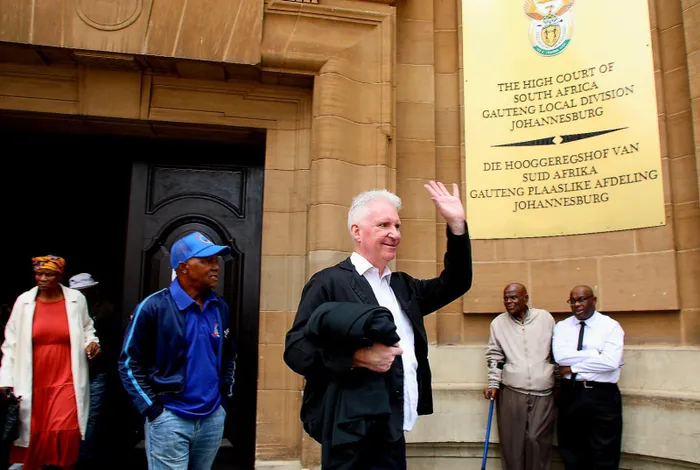
Lawyer Douglas Shaw leaving the Johannesburg High Court amid cheers from his clients in the R60 billion class action case against major banks.
Image: Timothy Bernard / Independent Newspapers
The attorney in the R60 billion foreclosure class action lawsuit against the nation's largest banks, Douglas Shaw, appeared in court this week to argue the case without a Fidelity Fund Certificate (FFC). The Legal Practice Council (LPC) has confirmed that it is "speedily" looking into this.
The certificate is a mandatory annual license for legal practitioners (attorneys, certain advocates) and property practitioners in South Africa, confirming they are authorised to operate a trust account and handle client funds.
"The LPC is aware of the appearance of Mr Shaw without being in possession of a valid FFC. We take this very seriously and will speedily investigate the matter and render a report to court. Practising without an FFC is a criminal offence," Ignatius Briel, Gauteng Provincial Director of the LPC, said.
Gauteng High Court, Johannesburg Judge Leonie Windell this week said she cannot allow Shaw to appear any longer in the case under the circumstances. She requested the LPC to conduct an investigation into the matter and to report back to her before the proceedings resume on March 26 on interlocutory matters regarding the case.
Despite the numerous challenges Shaw faced this week in court, especially being barred from presenting the case himself, the applicants said their belief in him is now even stronger.
Mirroring their support, Shabeer Khan, who also lost his home allegedly at the hands of the banks, in a message to his fellow applicants on Thursday made it clear that this journey is not over. “We have demonstrated resilience and strength under pressure”.
In the emotional message, Khan added: “When our counsel was put under pressure, something powerful happened: the people stood strong. The unity and presence of those supporting this action were felt in that courtroom. It was clear that this matter is bigger than individuals — it represents many families, many homes, and many voices seeking justice”.
The issues surrounding the Legal Practice Council (LPC) and the FFC became a focal point of the proceedings after counsel for one of the banks said they had received an anonymous tip-off that Shaw was appearing without having a certificate issued to him for 2026.
Despite attempts by Shaw to sort it out with the LPC, he still does not have the required document.
Khan, a pensioner from Durban, meanwhile, said all he wants is justice for himself and the people. “My house was repossessed in 2019 and the banks sold it for a song. My house was worth about a million and they sold it for R300, 000. They then sent me a letter saying that I owed them another R350 000. I feel that this has been a great injustice to me”. Khan said he was on the streets as a result.
According to Khan, all this led to him being blacklisted and unable to obtain a job. “I am so disappointed about what happened this week, but I know justice will be done”.
Khan said he still believed in Shaw. “He worked hard for years. He has spent thousands of hours on our case. He's a good man”.
Lungelo Lethu Human Rights Foundation, which was set up to protect homeowners who face eviction, initiated this case more than eight years ago.
Its president, Nkululeko Xhelithole, said they are supporting Shaw all the way. “We will not stop supporting him. He is one of the few lawyers who was willing to help us. Scores of people have been affected by evictions”. Xhelithole said it must be made clear that they will never allow the banks to derail their case.
It is, meanwhile, not clear what the future of this case is, as Shaw mentioned to the court that he had obtained the services of an attorney to argue the class action. But, as the banks pointed out, the new attorney must still come on record, and he must be vetted by all - one of the issues which will be vented next month.
While the judge and counsel for the banks agreed that the applicants must at least be given an opportunity to salvage their case, the banks are clear that they will oppose the certification of a class action suit, maintaining that the applicants were not dispossessed of their homes due to the fault of the banks.
zelda.venter@inl.co.za