
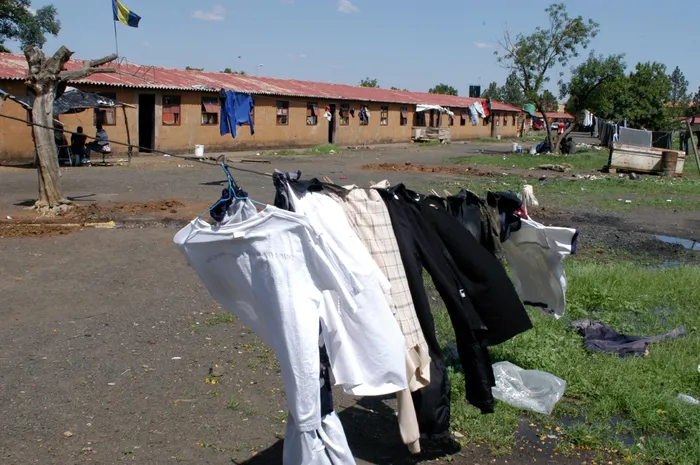
Hostels currently pose challenges to service delivery goals and safety standards as the high density and inadequate facilities make it difficult to maintain essential services, leading to issues like crime and health risks.
Image: Herbert Matimba
Hostels have the potential to play a transformative role in advancing human settlements by acting as transitional housing solutions that can alleviate urban overcrowding.
Redeveloping hostels into mixed-use spaces that integrate residential, commercial, and recreational facilities would support sustainable urban growth, says the City of Johannesburg's Department of Human Settlements.
“Hostels serve as crucial affordable housing options for many lower-income residents within the City of Johannesburg. To enhance their role, significant investment is needed in infrastructure, maintenance, and community services.
"Their improvement is essential for integrating these communities into the broader urban fabric. If current conditions persist, hostels may exacerbate issues of urban poverty and contribute to social instability.”
According to recent statistics from the city's Human Settlements Department, approximately 50,000 people currently reside in hostels.
In an official response to "Independent Media Property", the city says hostels currently pose challenges to the city’s service delivery goals and safety standards.
"It says the high density and inadequate facilities make it difficult to maintain essential services, leading to issues like crime and health risks.
“To address these challenges, the city's Human Settlements Department is working on an integrated approach that includes regularising service delivery, enhancing infrastructure, and implementing safety programs.”
The city says it has rolled out several initiatives for the improvement of hostels. This includes the Hostel Redevelopment Programme, aiming to refurbish and revitalise existing hostel structures.
Additionally, the city says it is exploring public-private partnerships to leverage outside investment for sustainable development.
“The intended impact of these programs is to provide dignified housing, improve living conditions, and ultimately integrate these communities more comprehensively into the urban environment.”
Hostels continue to play a critical role as entry-level accommodation for low-income households, job seekers, and the vulnerable, says Ald. Aaron Maluleka, a Member of the Mayoral Committee (MMC) for Human Settlements at the City of Tshwane.
He says that originally built under apartheid for migrant labour, they continue to function as low-cost accommodation close to economic opportunities.
“They act as pressure valves in the housing backlog by absorbing demand that formal housing delivery has not met. However, due to overcrowding, nonpayment of rental, ageing infrastructure and poor maintenance, they have also become hotspots for social vulnerability, crime, and governance challenges.”
If these issues are not addressed, Maluleka says the consequences will include worsening urban decay, increased crime, expansion of informal settlements, rising long-term infrastructure costs, declining public trust, and the entrenchment of spatial inequality.
The City of Tshwane says the last survey shows that about +- 16 000 people live in the hostel, but due to overcrowding, informal occupancy, and household extensions, exact figures are fluid and continuously updated through socio-economic surveys and audits. Mamelodi hostels seem to have a larger number of people, it says.
The MMC says that strategically, hostels represent both a legacy burden and a redevelopment opportunity. “If transformed, they could become well-located, high-density affordable housing assets that support inclusive urban growth.”
On the other hand, he says that if neglected, they risk undermining broader metropolitan development and spatial justice goals.
“They must be fully integrated into the City’s human settlements planning. Infrastructure upgrades, tenure reform, diversified housing typologies, and sustainable management models must be implemented. Social services, economic opportunities, and community facilities must form part of redevelopment,” Maluleka adds.
The City of Tshwane says it is cognisant of the challenges in the hostels and is working tirelessly with the communities towards improving the living conditions of the hostel occupants and integrating the precincts into sustainable human settlements.
The city is encouraging the hostel occupants and the community at large to take responsibility for safeguarding the infrastructure and taking care of the facilities. Although this is a long-term plan, work is underway, and the first phase of the refurbishment of the Mamelodi hostel is due to begin in the new financial year.
The city is implementing the Hostel Redevelopment Programme, which aims to redevelop hostels into Community Residential Units (CRUs) which range from studios to two-bedroom units, says the City of Cape Town's Mayoral Committee Member for Human Settlements, Councillor Carl Pophaim.
He says the existing hostel buildings are located within established urban areas where land availability is limited.
“This presents a significant challenge to site redevelopment because the current hostel dwellers need to be moved out of the existing hostels during redevelopment, accommodated elsewhere and then moved back to the newly refurbished or redeveloped rental units,” Pophaim says.
The City of Cape Town says an additional complexity is the requirement to accommodate more people than the site was originally envisaged to house, and to relocate, rebuild or refurbish, and then reinstate.
In addition, it says the overall housing requirements within the city are such that there is a constant challenge for any new development to be allocated not only to those that were originally accommodated on that site, but indeed to incorporate people from communities in the immediate vicinity as well.
It added that funding availability is the main determining factor for projects to start.
“Discussions with the Western Cape Government and the National Department of Human Settlements, regarding the provision of funding for future projects, are ongoing. Affected stakeholders are being engaged by the directorate on a way forward on the redevelopment plans.”
Independent Media Property